
B2B Digital Marketing in Singapore: The Definitive 2025 Strategy Guide

B2B digital marketing is the use of online channels — SEO, content, LinkedIn, paid media, email and marketing automation — to reach business buyers and generate qualified pipeline across long, multi-stakeholder sales cycles. In Singapore’s tech-dense, export-driven economy, it is now the primary engine for lead generation and revenue growth for local SMEs and regional headquarters alike.

The "handshake deal" that once defined business-to-business commerce in Singapore has not disappeared — but it now arrives at the very end of a long digital trail. By the time a procurement lead or CTO speaks to your sales team, they have typically consumed your website, read peer reviews, watched a demo video and shortlisted two or three vendors. For B2B organisations across Singapore and the wider APAC region, mastering the digital layer of that journey is no longer optional. This guide is the definitive, Singapore-focused blueprint for doing it well.
What Is B2B Digital Marketing?
B2B digital marketing is any online strategy, channel or content directed at another business or organisation rather than an individual consumer. Its purpose is to attract, educate, nurture and convert professional buyers — often a committee of them — into revenue.
Unlike B2C marketing, which frequently leans on emotion and impulse, B2B marketing sells logic, risk reduction and measurable return on investment (ROI). A B2B purchase — say, an enterprise SaaS platform, industrial equipment or a managed IT contract — is a considered decision reviewed by finance, operations, IT and legal. The marketing must therefore speak to multiple stakeholders, each with a different priority.
Core characteristics of B2B digital marketing include:
- Longer sales cycles — typically three to twelve months, sometimes longer for enterprise deals.
- Buying committees — Gartner research finds the average B2B purchase involves six to ten decision-makers.
- Higher deal values — a single closed account can be worth six or seven figures over its lifetime.
- Rational, evidence-led content — whitepapers, case studies, ROI calculators and technical comparisons.
- Relationship focus — the goal is long-term partnership, not a one-off transaction.
How Is B2B Digital Marketing Different From B2C?
The fundamental difference is that B2B marketing targets a rational buying committee over a long cycle, while B2C targets an individual over a short one. This changes everything from tone to channel selection to measurement.
| Dimension | B2B Digital Marketing | B2C Digital Marketing |
|---|---|---|
| Decision-makers | 6–10 people (buying committee) | Usually 1 individual |
| Sales cycle | 3–12+ months | Minutes to days |
| Purchase driver | Logic, ROI, risk reduction | Emotion, desire, convenience |
| Average deal value | High (often S$10k–S$1m+) | Lower |
| Primary channels | LinkedIn, SEO, email, ABM, events | Instagram, TikTok, retail, influencers |
| Key content | Whitepapers, case studies, demos | Reels, promotions, lifestyle imagery |
| Success metric | Pipeline & revenue influenced | Direct sales & ROAS |
Is Coca-Cola B2C or B2B? Coca-Cola is primarily a B2C brand because it markets to individual consumers, but it also operates a substantial B2B arm — selling syrup, distribution and vending partnerships to restaurants, retailers and bottlers. Many large companies run both models simultaneously.
Why Do B2B Companies in Singapore Need Digital Marketing?
B2B companies need digital marketing because modern buyers complete most of their research independently before ever contacting sales. Forrester and Gartner data consistently show B2B buyers are roughly 60–70% through the buying journey before engaging a vendor, meaning your digital presence is doing the selling long before a salesperson does.
Singapore adds specific urgency to this. The city-state has one of the highest internet and LinkedIn penetration rates in the world, a dense concentration of regional headquarters, and a government-backed digital economy through initiatives like the Infocomm Media Development Authority (IMDA) and the Productivity Solutions Grant (PSG), which co-funds digital marketing tools for eligible Singapore-registered SMEs. Businesses here also market to the wider ASEAN region — a market of over 670 million people — making digital reach essential.
Three reasons B2B digital marketing is indispensable:
- Precise targeting of high-value accounts. Platforms enable Account-Based Marketing (ABM) at scale — targeting specific industries, company sizes and even individual job titles across Singapore, Malaysia, Indonesia, Vietnam and beyond.
- Full-funnel coverage. Your brand appears at the awareness, consideration and decision stages, whether a prospect wants an industry report or a technical comparison.
- Data-driven ROI. Unlike a print ad in the MRT or a Straits Times spread, digital channels reveal exactly which whitepaper triggered a consultation or which LinkedIn campaign closed a contract.
What Are the Best B2B Digital Marketing Strategies?
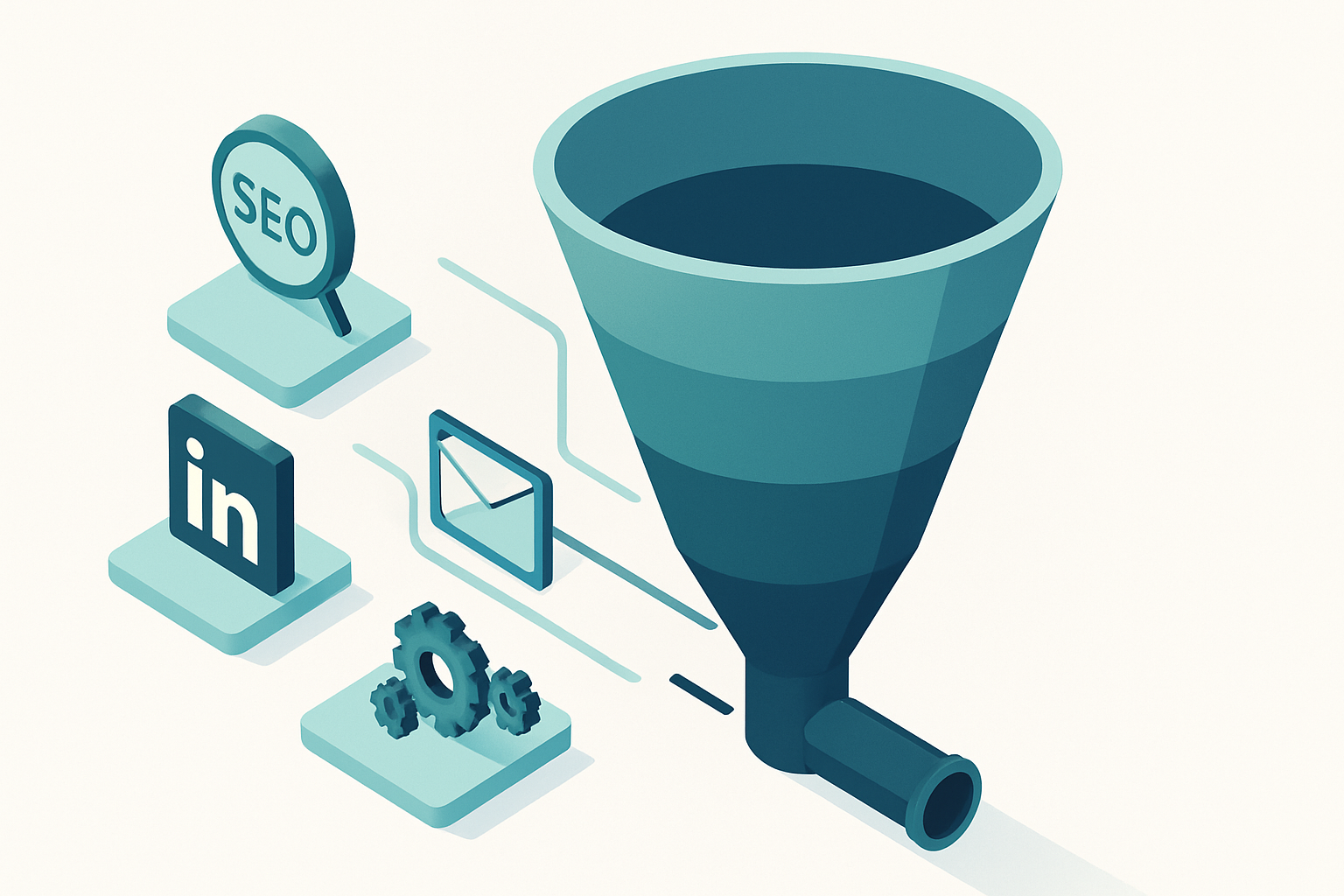
The best B2B digital marketing strategies combine organic authority (SEO and content), targeted demand generation (LinkedIn and paid media), and disciplined nurturing (email automation and ABM) into one integrated, full-funnel engine. No single channel wins alone.
1. SEO and GEO (Generative Engine Optimisation)
Search engine optimisation remains the foundation of organic discovery — most B2B research begins with a search query. But the rise of AI answer engines has introduced Generative Engine Optimisation (GEO): structuring content so it is cited inside AI-generated summaries from ChatGPT, Google’s AI Overviews and Perplexity. Winning brands now optimise for both blue links and machine answers by publishing clear, factual, well-structured content that answers real buyer questions, in line with Google’s own search guidance. A disciplined SEO services programme underpins this organic visibility over the long term.
2. Content Marketing and Thought Leadership
Content is how B2B brands demonstrate expertise before a sale. High-performing formats include pillar guides, original research, case studies, technical documentation and webinars. In Singapore and across APAC, localised content — addressing regional compliance, PDPA obligations, language nuance and market conditions — dramatically outperforms generic global material. Pairing evergreen assets with real-time content that responds to live moments can further sharpen relevance and engagement.
3. LinkedIn Marketing
LinkedIn is the undisputed leader for B2B in Singapore, where professional adoption is exceptionally high. Use it for organic thought leadership from founders and executives, and for precise paid targeting of the buying committee by job title, industry, company and seniority. Employee advocacy and executive personal branding amplify reach at near-zero cost. For committee-level demand generation, a focused approach to LinkedIn Ads for B2B often delivers the most qualified pipeline.
4. Marketing Automation and Email
Email consistently delivers among the highest ROI of any B2B channel. Automation lets you run nurture sequences — "drip campaigns" — that keep your brand top-of-mind across a six-to-twelve-month cycle, triggering the right message based on a prospect’s behaviour.
5. Account-Based Marketing (ABM)
ABM flips the funnel: instead of casting wide, you identify a defined list of high-value target accounts and surround them with coordinated, personalised messaging across LinkedIn, email, display and events. It suits Singapore’s enterprise and regional-HQ market especially well.
6. Paid Media and Retargeting
Google Search, LinkedIn Ads and programmatic display capture in-market demand and re-engage prospects who dropped off. Retargeting is critical for long cycles — it maintains presence during the months a buyer is quietly evaluating options. Scaling reach across the display ecosystem is where a well-managed programmatic advertising approach adds value.
7. Marketing Technology (MarTech) and AI
Modern MarTech stacks use AI for predictive lead scoring, dynamic website personalisation and content generation — allowing lean Singapore marketing teams to deliver personalised experiences at scale.
What Are the 4 Types of B2B Marketing?
The four commonly cited types of B2B marketing are: businesses that sell to producers, to resellers, to governments, and to institutions. These describe the type of buyer, and each demands a slightly different digital approach.
- Producers — companies that buy goods and services to make their own products (e.g. a manufacturer buying components or software).
- Resellers — wholesalers and retailers who buy to sell on; digital channel-partner programmes matter here.
- Governments — public-sector buyers with formal tender and procurement processes; in Singapore, this means GeBIZ, alignment with agencies like IMDA and GovTech, and strict compliance-led messaging.
- Institutions — universities, hospitals and non-profits with committee-based, budget-conscious decision-making.
In practice, most agencies also frame B2B marketing by its four functional pillars: content marketing, digital/social marketing, SEO and email marketing — the operational levers used to reach any of the buyer types above.
What Is the Rule of 7 in B2B Marketing?
The Rule of 7 states that a prospect needs to encounter your brand at least seven times before they take action, such as booking a meeting or requesting a quote. In B2B — with its long cycles and cautious committees — that number is often higher in practice.
This is precisely why an integrated, multi-channel approach matters. A prospect might see your LinkedIn post, read a blog you rank for, receive a nurture email, notice a retargeting ad and encounter your brand at an industry event — each touch building the "surround-sound" familiarity that establishes credibility before the first sales conversation. In Singapore’s tight, relationship-driven business community, consistent repetition across channels is often the difference between being shortlisted and being ignored.
How Do You Measure the Success of B2B Digital Marketing Campaigns?
You measure B2B digital marketing success by pipeline health and revenue influence, not vanity metrics like likes or raw traffic. Because sales cycles are long, the right metrics track the journey from lead to closed deal.
The most important B2B metrics are:
- Marketing-Qualified Leads (MQLs) and Sales-Qualified Leads (SQLs) — volume and quality of leads by stage.
- Cost Per Lead (CPL) and Customer Acquisition Cost (CAC) — total spend to acquire one customer.
- Pipeline and revenue influenced — the dollar value of opportunities marketing touched.
- Customer Lifetime Value (CLV) — total revenue expected from an account over the relationship.
- Conversion rate by funnel stage — where prospects progress or drop off.
- Return on Ad Spend (ROAS) — revenue per dollar of paid media.
For technology brands specifically, the strongest measurement approach ties every campaign to CRM-based revenue attribution. Connect your marketing platform (HubSpot, Marketo or similar) to your CRM, use multi-touch attribution to credit each channel fairly across the long cycle, and report on pipeline and closed-won revenue rather than clicks. In Singapore, where deals often span multiple ASEAN markets, geo-tagging leads and reporting by market keeps regional performance transparent.

What Are the Biggest Challenges in B2B Digital Marketing — and How Do You Solve Them?
The biggest B2B challenges are long sales cycles, hard-to-reach decision-makers, and proving ROI — all addressable with the right combination of content, targeting and measurement.
- Long, complex sales cycles. Solution: Use retargeting and educational nurture content to sustain engagement, and equip internal champions with sales-enablement tools like ROI calculators so they can sell your solution upward.
- Reaching key decision-makers past gatekeepers. Solution: Multi-channel ABM — surround target accounts with LinkedIn thought leadership, authoritative search rankings and targeted display to build credibility before the first meeting.
- Proving marketing ROI to leadership. Solution: Closed-loop reporting between marketing platform and CRM, focused on pipeline and revenue rather than activity metrics.
- Standing out in a crowded Singapore and APAC market. Solution: Original research, localised content and genuine thought leadership rather than generic global messaging.
What Are the B2B Digital Marketing Trends for 2025?
The defining B2B trends for 2025 are AI-powered personalisation, Generative Engine Optimisation, and a shift toward buyer self-service — buyers want to research, compare and even transact with minimal sales contact.
Key trends to act on:
- AI everywhere. From predictive lead scoring to AI-assisted content and chat, artificial intelligence is compressing the work of large teams into lean operations.
- GEO and AI search. Being cited in AI Overviews and answer engines is becoming as important as ranking on page one.
- Video and short-form. Demo clips, customer stories and executive commentary drive engagement across LinkedIn and YouTube.
- First-party data. With cookie deprecation and tightening privacy rules (including Singapore’s Personal Data Protection Act, PDPA, enforced by the PDPC), owned data and consent-based marketing are now strategic priorities.
- Community and dark social. Peer discussions in private groups, Slack communities and WhatsApp increasingly influence B2B decisions in Singapore — even though they are hard to track.
- Sustainability and trust signals. ESG credentials and transparent proof points matter more to enterprise buyers.
How Do You Choose a B2B Digital Marketing Agency in Singapore?
Choose a B2B digital marketing agency by evaluating their B2B-specific experience, transparency of reporting, understanding of your industry and sales cycle, and proof of pipeline results — not just awards or follower counts.
Questions to ask any prospective agency:
- Do they specialise in B2B, or mostly run B2C campaigns?
- Can they show case studies with pipeline or revenue outcomes, not just traffic?
- Do they understand ABM, marketing automation and CRM integration?
- Are they familiar with your target markets — Singapore, ASEAN and the wider APAC region?
- Are they familiar with local realities like PSG grant eligibility, PDPA compliance and GeBIZ procurement?
- How do they report, and how often?
Whether you search for a "B2B digital marketing agency Singapore," a "B2B digital marketing consultant Singapore," or a "B2B lead generation agency Singapore," the same principles apply. Regional players such as Construct Digital, Callbox and Halo Tech Media focus on the APAC B2B space, while global platforms like Salesforce and LinkedIn publish the frameworks the industry runs on. For companies expanding beyond ASEAN into North Asian markets like China, an agency with WeChat, Baidu SEO and local compliance experience is essential — the digital ecosystem there differs fundamentally from the West, and a specialist Xiaohongshu marketing partner can help bridge the gap for China-facing brands.
Typical B2B digital marketing services an agency provides include:
- Strategy, positioning and buyer-persona development
- SEO, GEO and content marketing
- LinkedIn organic and paid campaign management
- Marketing automation and email nurture build-out
- Account-Based Marketing programmes
- Paid search and programmatic advertising
- Analytics, attribution and dashboard reporting
Frequently Asked Questions
What is B2B digital marketing?
B2B digital marketing is the practice of using online channels — including search, content, LinkedIn, paid media, email and automation — to attract, nurture and convert other businesses across considered, multi-stakeholder buying journeys. Its goal is qualified pipeline and long-term revenue rather than one-off sales.
Does digital marketing work for B2B businesses?
Yes, digital marketing works well for B2B businesses because most buyers now research independently online before contacting sales. Companies that maintain strong SEO, LinkedIn presence and nurture programmes consistently tend to generate more qualified pipeline than those relying on cold outreach alone.
How is B2B digital marketing different from B2C?
B2B digital marketing targets a rational buying committee over a long sales cycle with ROI-focused, evidence-led content, whereas B2C targets individual consumers over short, emotion-driven cycles. B2B prioritises trust, expertise and pipeline, while B2C prioritises impulse and immediate conversion.
How much does B2B digital marketing cost in Singapore?
B2B digital marketing costs in Singapore vary widely, with SMEs typically investing from S$2,000–S$8,000 per month on retainers and enterprises spending considerably more on integrated campaigns. Eligible Singapore-registered SMEs can offset part of their spend on approved digital marketing solutions through the Productivity Solutions Grant (PSG) administered by Enterprise Singapore.
Is the Productivity Solutions Grant (PSG) available for B2B digital marketing in Singapore?
Yes, the Productivity Solutions Grant (PSG) can co-fund pre-approved digital marketing solutions for eligible Singapore-registered SMEs, subject to prevailing support levels set by Enterprise Singapore and IMDA. Because supportable solutions and funding tiers change, confirm current eligibility on the official GoBusiness portal before committing to an agency package.
What is the best channel for B2B digital marketing in Singapore?
LinkedIn is generally the single best channel for B2B digital marketing in Singapore, thanks to the country’s exceptionally high professional adoption and precise targeting of decision-makers by role, industry and seniority. However, the highest-performing programmes combine LinkedIn with SEO, email automation and account-based marketing rather than relying on one channel.
How do you measure B2B digital marketing performance?
You measure B2B digital marketing performance using pipeline-oriented metrics such as marketing-qualified leads, cost per lead, customer acquisition cost, pipeline and revenue influenced, and stage-by-stage conversion rates. These are best reported through CRM-integrated attribution rather than vanity engagement metrics.
What is the Rule of 7 in B2B marketing?
The Rule of 7 is the principle that a prospect needs to encounter your brand at least seven times before taking action. In B2B this often requires more touches, which is why integrated multi-channel campaigns across LinkedIn, search, email and events are so effective.
Do I need to comply with PDPA when running B2B marketing in Singapore?
Yes, Singapore’s Personal Data Protection Act (PDPA) governs how you collect, use and disclose personal data, including business contacts’ work emails and phone numbers used in nurture and outreach campaigns. Maintain clear consent, honour Do-Not-Call (DNC) obligations, and keep first-party data practices auditable to stay compliant with the PDPC.
Which B2B digital marketing trends matter most in 2025?
The most important 2025 trends are AI-powered personalisation, Generative Engine Optimisation for AI search, buyer self-service, first-party data strategies driven by privacy laws like Singapore’s PDPA, and the growing influence of community and video content.
Building a sustainable B2B lead-generation engine is a marathon, not a sprint — and it demands a partner who understands both technical excellence and the realities of long, committee-led sales cycles across Singapore and APAC. If your organisation is ready to strengthen its digital presence and influence the right decision-makers, get in touch with Halo Tech Media for a strategy conversation tailored to the Singapore market.
 Back
Back