
SEO vs SEM in Singapore: The Definitive 2026 Guide to Differences, Costs & Which to Choose

SEO (search engine optimisation) is the practice of earning unpaid, organic search rankings, while SEM (search engine marketing) is the broader discipline of gaining search visibility through paid ads such as Google Ads. In short, SEO is a subset of SEM — SEO builds long-term authority, while SEM delivers instant, budget-driven traffic.
For Singapore businesses navigating one of Asia-Pacific’s most competitive digital markets, understanding the difference between SEO and SEM is not academic — it directly determines how you allocate budget, how fast you see results, and how sustainably you grow. This pillar guide unpacks every distinction, cost consideration, and strategic decision, with concrete local context throughout.
What Is the Difference Between SEO and SEM?
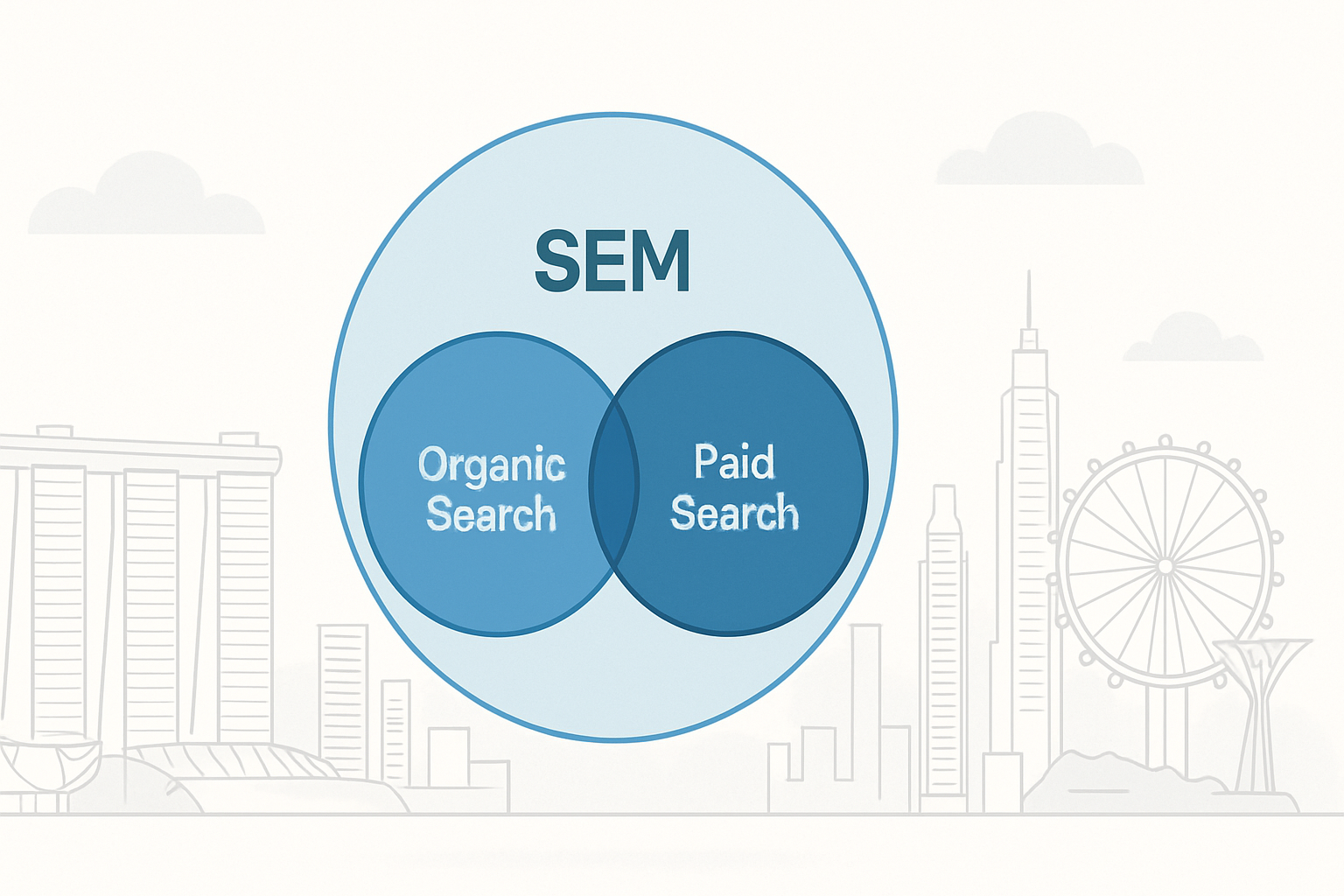
The core difference is that SEO earns organic visibility for free through optimisation, whereas SEM encompasses both organic and paid search tactics to secure visibility on search engine results pages (SERPs).
Search engine marketing (SEM) is the umbrella term for all activity that increases a website’s visibility on search engines. Historically, SEM referred to both organic and paid search. Today, most marketers use "SEM" as shorthand for paid search advertising specifically — pay-per-click (PPC) campaigns run through platforms like Google Ads and Microsoft Advertising.
Here is how the two disciplines break down:
- SEO (Search Engine Optimisation): Improving on-page content, technical health, site speed, mobile usability, and backlink authority to rank organically. You pay for tools, talent and time — not for clicks.
- SEM (Search Engine Marketing): Bidding on keywords so your ad appears at the top of the SERP, marked "Sponsored". You pay each time a user clicks (PPC).
In the Singapore market, where Google commands over 95% of search share according to StatCounter data, both channels revolve around the same ecosystem — but the mechanics, timelines and economics differ sharply.
Is SEO a Type of SEM?
Yes — technically SEO is a component of SEM, because search engine marketing is the broad category that includes every method of gaining search visibility, both paid and organic.
The confusion arises because industry usage has drifted. When digital marketing matured in the 2000s, "SEM" described the entire practice of marketing on search engines. As paid advertising grew, the term narrowed. Today:
- Academic and classic definition: SEM = SEO + Paid Search.
- Common industry usage: SEM = Paid Search only (SEO is treated separately).
At Halo Tech Media we adopt the classic definition when advising clients, because it forces a holistic view — the organic and paid halves of search should be planned together, not in silos.
Is Google Ads SEO or SEM?
Google Ads is SEM, not SEO, because it is a paid advertising platform where you bid to display ads on search results and across Google’s network.
Google Ads (formerly Google AdWords) is the engine behind most Singapore paid-search campaigns. When you run a search campaign, your ad competes in a real-time auction based on your bid and your Quality Score — Google’s measure of ad relevance, expected click-through rate and landing-page experience. A strong Quality Score lowers your cost-per-click, which is why good SEO practices (fast, relevant landing pages) actually improve paid performance too. This overlap is precisely why the two channels reward integrated management.
What Are the 4 Types of SEO?
The four main types of SEO are on-page SEO, off-page SEO, technical SEO, and local SEO — each addressing a different ranking lever.
| Type of SEO | What It Covers | Singapore/APAC Relevance |
|---|---|---|
| On-page SEO | Content quality, keyword targeting, title tags, meta descriptions, internal links | Optimising for bilingual queries (English + Mandarin) and local intent |
| Off-page SEO | Backlinks, digital PR, brand mentions, authority signals | Earning links from .sg domains and regional publications |
| Technical SEO | Site speed, mobile-first indexing, crawlability, structured data, Core Web Vitals | Critical given Singapore’s high mobile usage (~90% smartphone penetration) |
| Local SEO | Google Business Profile, local citations, reviews, "near me" optimisation | Essential for F&B, retail and service businesses across Singapore’s neighbourhoods, from Orchard Road to the HDB heartlands |
Some practitioners add a fifth category — content/EEAT SEO — reflecting Google’s growing emphasis on Experience, Expertise, Authoritativeness and Trustworthiness, especially in "Your Money or Your Life" sectors like finance and healthcare that are heavily regulated in Singapore (for example, under MAS and MOH guidelines).
SEO vs SEM: Which Is Better for My Business?
Neither is universally "better" — SEO delivers sustainable, compounding returns over months, while SEM delivers immediate, controllable traffic you pay for continuously; the right choice depends on your goals, budget and timeline.
Use this quick decision framework:
- Choose SEO if you want long-term brand authority, lower cost-per-acquisition over time, and you can wait 3–6 months for meaningful traction.
- Choose SEM if you need traffic this week, are launching a product or event, testing new markets, or dominating high-intent commercial keywords immediately.
- Choose both if you want the fastest ramp plus durable growth — the approach most established Singapore SMEs and enterprises adopt.

How Do SEO and SEM Compare Side by Side?
SEO and SEM differ across cost model, speed, longevity, click-through behaviour and trust — the table below summarises the practical trade-offs.
| Factor | SEO (Organic) | SEM (Paid Search) |
|---|---|---|
| Cost model | Investment in content, tools, expertise; no cost per click | Pay-per-click; you pay for every visit |
| Time to results | 3–6 months typically | Immediate — within hours of launch |
| Longevity | Compounds; traffic continues after spend slows | Stops the moment budget stops |
| Position on SERP | Below ads, in organic listings | Top and bottom "Sponsored" slots |
| Trust/CTR | Higher trust; many users skip ads | Lower trust but strong for high-intent buyers |
| Best for | Authority, evergreen content, long-tail demand | Launches, promotions, events, competitive keywords |
| Measurability | Attribution harder, delayed | Precise, real-time ROI tracking |
| Scalability | Limited by content velocity | Instantly scalable with budget |
The key insight for Singapore marketers: paid clicks in competitive verticals — legal, insurance, property, education — can exceed S$10–S$20 per click, so a pure SEM strategy becomes expensive fast. SEO offsets this by capturing the same demand organically over time.
SEO vs SEM vs PPC: Are They the Same Thing?
No — PPC is a pricing model within SEM, not a separate discipline; SEM is the paid-search practice, and PPC (pay-per-click) is how you are billed for it.
To untangle the acronyms:
- SEO — earning organic rankings, no click cost.
- SEM — marketing on search engines, now commonly meaning paid search.
- PPC — the billing model where advertisers pay per click; it powers most SEM campaigns and also applies to social and display ads.
So a Google search ad is SEM delivered via a PPC model. A Facebook ad billed per click is also PPC — but it is social advertising, not SEM. PPC is the "how you pay", while SEM is the "where you advertise".
SEO vs SEM vs SMM: How Does Social Media Marketing Fit In?
SMM (social media marketing) is a distinct channel from SEO and SEM — it drives visibility and engagement on platforms like Instagram, TikTok, Facebook and LinkedIn rather than on search engine results pages.
Here is how the three relate:
- SEO & SEM operate on search engines, capturing existing demand — users actively searching for something.
- SMM operates on social platforms, creating new demand — reaching users while they scroll, based on interests and behaviour.
In Singapore, where TikTok, Instagram and Facebook penetration is among the highest in Southeast Asia, a mature strategy blends all three: SEO for evergreen search demand, SEM for high-intent conversions, and SMM for brand discovery and community building. Increasingly, social platforms also function as search engines — younger consumers in Singapore frequently search TikTok and Instagram for hawker recommendations, cafes and products, blurring the traditional lines.
How Much Does SEO vs SEM Cost in Singapore?
SEO in Singapore typically costs between S$1,000 and S$5,000+ per month for agency retainers, while SEM cost depends entirely on your ad budget plus management fees — often 15–20% of ad spend.
Indicative Singapore market ranges:
- SEO retainers: S$1,000–S$3,000/month for SMEs; S$5,000+ for competitive or enterprise campaigns.
- SEM management fees: 15–20% of monthly ad spend, or a fixed retainer for smaller accounts.
- Cost-per-click: From under S$1 for niche terms to S$15–S$30+ in banking, legal and insurance.
- One-off SEO audits: S$1,500–S$5,000 depending on site size.
Tip for Singapore SMEs: SEO and SEM services may qualify for support under schemes like the Productivity Solutions Grant (PSG) or Enterprise Development Grant (EDG) when bundled with pre-approved digital marketing solutions — worth checking with your provider before committing budget.
The important distinction: with SEO, your spend builds an appreciating asset — content and authority that keep working. With SEM, your spend is consumed; stop paying and traffic disappears the same day. Over a 12–24 month horizon, SEO usually delivers a lower blended cost-per-acquisition, which is why Halo Tech Media generally recommends front-loading SEM for speed while building SEO for compounding efficiency.
What Are the Pros and Cons of SEO and SEM?
SEO’s main advantages are sustainability and trust, while its drawbacks are slow results and algorithm risk; SEM’s strengths are speed and control, offset by ongoing cost and short-lived impact.
SEO — Pros:
- Compounding, long-term traffic
- Higher user trust and click-through
- Strong cost-efficiency over time
- Builds a defensible content asset
SEO — Cons:
- Slow to show results (months)
- Vulnerable to algorithm updates
- Requires sustained content and technical effort
SEM — Pros:
- Immediate visibility and leads
- Precise targeting and budget control
- Excellent for testing keywords and offers
- Transparent, real-time ROI data
SEM — Cons:
- Costs recur; no residual value
- Click costs rise in competitive niches
- "Ad blindness" reduces some CTR
- Requires ongoing management to avoid waste
How Do SEO and SEM Work Together?
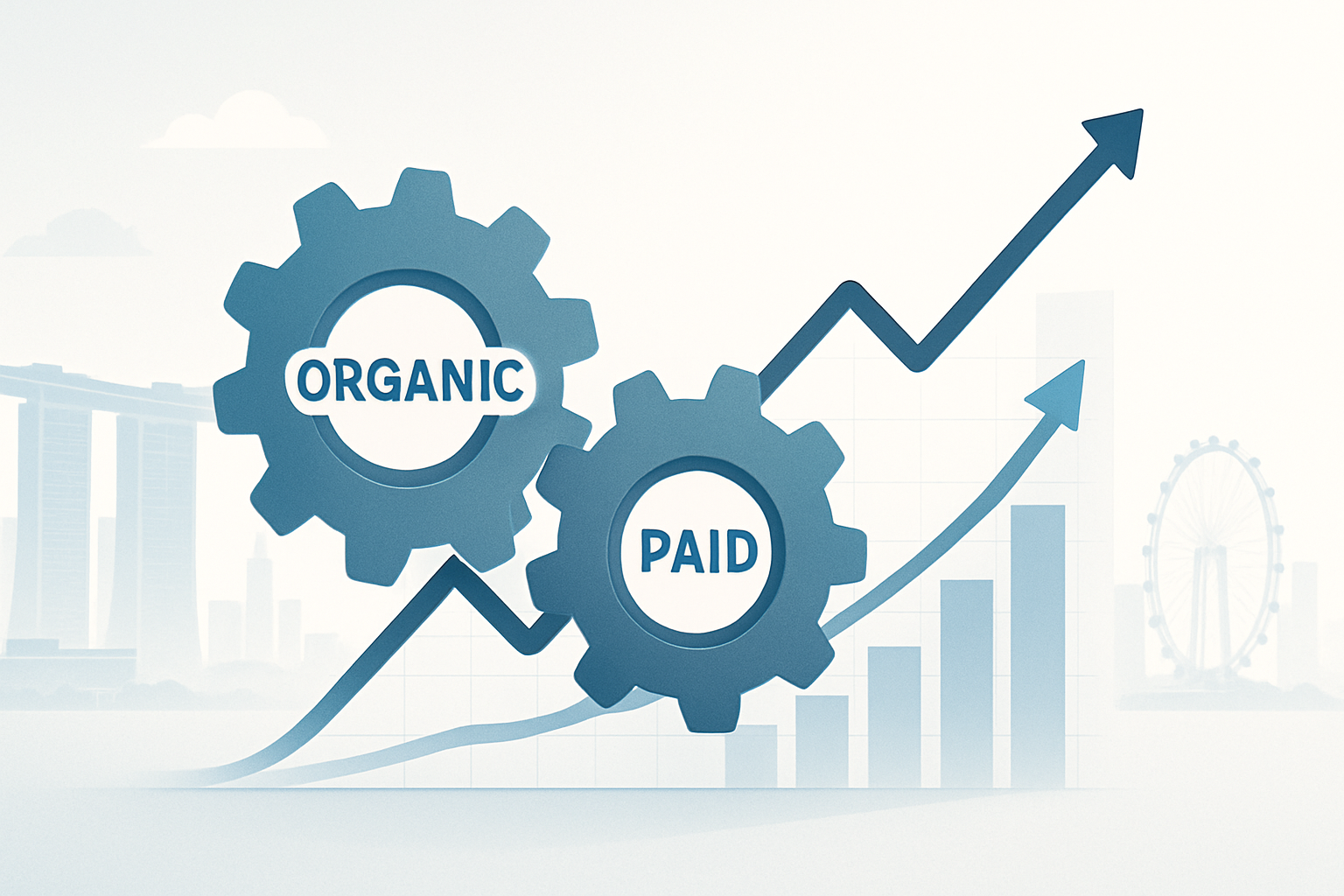
SEO and SEM work best in tandem — paid campaigns deliver instant data and coverage while organic rankings build durable equity, and each channel feeds insights to the other.
Integration tactics Halo Tech Media deploys for Singapore clients:
- Keyword intelligence sharing: SEM reveals which keywords convert fastest; feed those into your SEO content roadmap.
- SERP dominance: Ranking organically and running an ad for the same term increases total SERP real estate and total clicks.
- Landing page synergy: SEO-optimised pages lift Google Ads Quality Score, reducing your cost-per-click.
- Retargeting the pipeline: Capture organic visitors, then retarget them with paid ads to close.
- Seasonal balance: Lean on SEM during launches, National Day promotions, Great Singapore Sale or festive peaks like Chinese New Year and Hari Raya; rely on SEO for baseline year-round demand.
Is SEO Dead or Evolving in 2026?
SEO is not dead — it is evolving rapidly, shifting from keyword ranking toward AI-driven search, generative answers and entity-based optimisation.
The rise of Google’s AI Overviews (SGE), ChatGPT and answer engines has changed how visibility works, but not eliminated the need for it. Instead of chasing ten blue links, modern SEO focuses on:
- Answer Engine Optimisation (AEO): structuring content so AI assistants cite you.
- EEAT signals: demonstrating genuine expertise and trust, vital for Singapore’s regulated finance and healthcare sectors.
- Entity and structured data: helping engines understand your brand and offerings.
- Zero-click resilience: capturing brand impressions even when users don’t click through.
Meanwhile SEM is also evolving toward AI-managed bidding (Performance Max, Smart Bidding), giving advertisers less manual control but better automation. Both disciplines are becoming more AI-native — a reason to work with practitioners who track these shifts closely.
FAQ
Is SEM better than SEO for a new Singapore business?
For a brand-new business needing immediate visibility and leads, SEM is usually the faster starting point because it delivers traffic within hours, whereas SEO takes months to gain traction. Most new ventures benefit from running SEM first while simultaneously building SEO foundations so that organic traffic can gradually reduce reliance on paid spend.
Can I do SEO and SEM at the same time?
Yes, running SEO and SEM together is the recommended approach for most businesses because the channels reinforce each other. Paid campaigns generate rapid conversion data that sharpens your organic keyword strategy, while strong organic landing pages improve your Google Ads Quality Score and lower your cost-per-click.
Does SEM affect SEO rankings?
No, running paid Google Ads does not directly improve or harm your organic rankings, as Google keeps the two systems separate. However, SEM can indirectly benefit SEO by increasing brand searches, driving traffic that improves engagement signals, and revealing high-converting keywords worth targeting organically.
How long does SEO take to show results in Singapore?
SEO typically takes three to six months to produce meaningful results in the Singapore market, though competitive industries such as finance, property and legal services may require six to twelve months. The timeline depends on your site’s existing authority, competition level, and the consistency of your content and technical work.
What is the difference between SEM and PPC?
SEM is the overall practice of marketing on search engines, while PPC is the pay-per-click billing model used to run most SEM campaigns. In practice, nearly all search-based SEM uses a PPC model, but PPC also applies to advertising on social media and display networks, making it a broader pricing concept.
Which is cheaper, SEO or SEM?
Over the long term SEO is generally cheaper because organic traffic continues without a per-click cost, whereas SEM incurs ongoing charges for every click. In the short term, however, SEM can appear cheaper because it produces immediate returns, while SEO requires upfront investment before results materialise.
Do people trust organic results or paid ads more?
Research consistently shows that most users trust organic search results more than paid advertisements, and a significant share skip ads entirely. That said, paid ads perform strongly for high-intent commercial and transactional searches, where users are ready to buy and value the convenience of a relevant top result.
Is Google Ads worth it for small Singapore businesses?
Google Ads can be highly worthwhile for small Singapore businesses when campaigns are tightly targeted, well-managed and focused on high-intent keywords with a clear conversion path. The key is disciplined budget control and continuous optimisation, since poorly managed campaigns can waste spend quickly in competitive local auctions.
Are there grants to help Singapore SMEs pay for SEO or SEM?
Some digital marketing and SEO solutions in Singapore are pre-approved under government schemes such as the Productivity Solutions Grant (PSG), which can subsidise a portion of eligible costs for qualifying SMEs. Availability changes over time, so confirm current eligibility with your agency and check the official GoBusiness or Enterprise Singapore listings before purchasing.
The Bottom Line
SEO and SEM are not competitors — they are complementary halves of a complete search strategy. SEO builds the durable, trusted foundation that compounds in value; SEM delivers the immediate reach and precise targeting that keeps your pipeline full while that foundation grows. The most successful Singapore and APAC brands invest in both, calibrated to their stage, budget and goals.
If you’re weighing SEO against SEM — or want a unified strategy that gets the balance right for your market — the team at Halo Tech Media would be glad to help. Get in touch with Halo Tech Media for a tailored search strategy built for Singapore and the wider APAC region.
Ready to act on this? Explore our Google Ads or book a free consultation.
 Back
Back