
Event Management System in Singapore: The Complete 2026 Guide

An event management system is software that centralises every stage of planning and running an event — registration, ticketing, attendee data, communications, on-site check-in and post-event analytics — into one connected platform. In Singapore, organisers use these systems to automate manual admin, boost attendance and prove event ROI with real data.
For agencies, associations, MICE operators and enterprises across the region, choosing the right event management system (EMS) has become a core commercial decision rather than a back-office afterthought. This guide from Halo Tech Media breaks down what these platforms do, the features that matter, how the major types differ, what they cost, and how to select one for the Singapore and wider APAC market.

What is an event management system?
An event management system is a unified software platform that handles the full event lifecycle — from creating an event page and collecting registrations to managing attendees on the day and reporting on results afterwards. Rather than juggling spreadsheets, email chains and disconnected tools, organisers run everything from a single dashboard.
At its core, an EMS answers three questions for every event: who is coming, how do we communicate with them, and did the event succeed? Modern systems extend far beyond simple ticketing to include marketing automation, sponsor management, mobile apps and integrations with CRM and finance systems.
The terminology overlaps heavily. "Event management software", "event management system software" and "event management software system" all describe the same category. A web-based event management system simply means the platform runs in the cloud through a browser, so there is nothing to install and teams can collaborate remotely — the standard delivery model today.
What are the core features of an event management system?
The essential features of an event management system fall into five clusters that mirror the event lifecycle: registration, marketing, attendee engagement, on-site operations and analytics.
- Registration and ticketing — customisable forms, tiered pricing, promo codes, group bookings and secure payment collection in SGD and other currencies, with support for local gateways and PayNow.
- Event website builder — a branded, mobile-responsive landing page or microsite, often used as a standalone event management system website.
- RSVP and invitation management — an event RSVP management system tracks responses, sends automated reminders and manages waitlists.
- Attendee management — an event attendee management system stores profiles, dietary and access needs, session choices and communication history.
- Email and marketing automation — segmented campaigns, drip sequences and abandoned-registration follow-ups.
- On-site tools — QR-code check-in, badge printing, self-service kiosks and access control.
- Mobile event app — agendas, networking, live polling, Q&A and push notifications.
- Virtual and hybrid delivery — live streaming, breakout rooms and on-demand content for a virtual event management system.
- Sponsor and exhibitor management — lead retrieval, booth allocation and branded visibility.
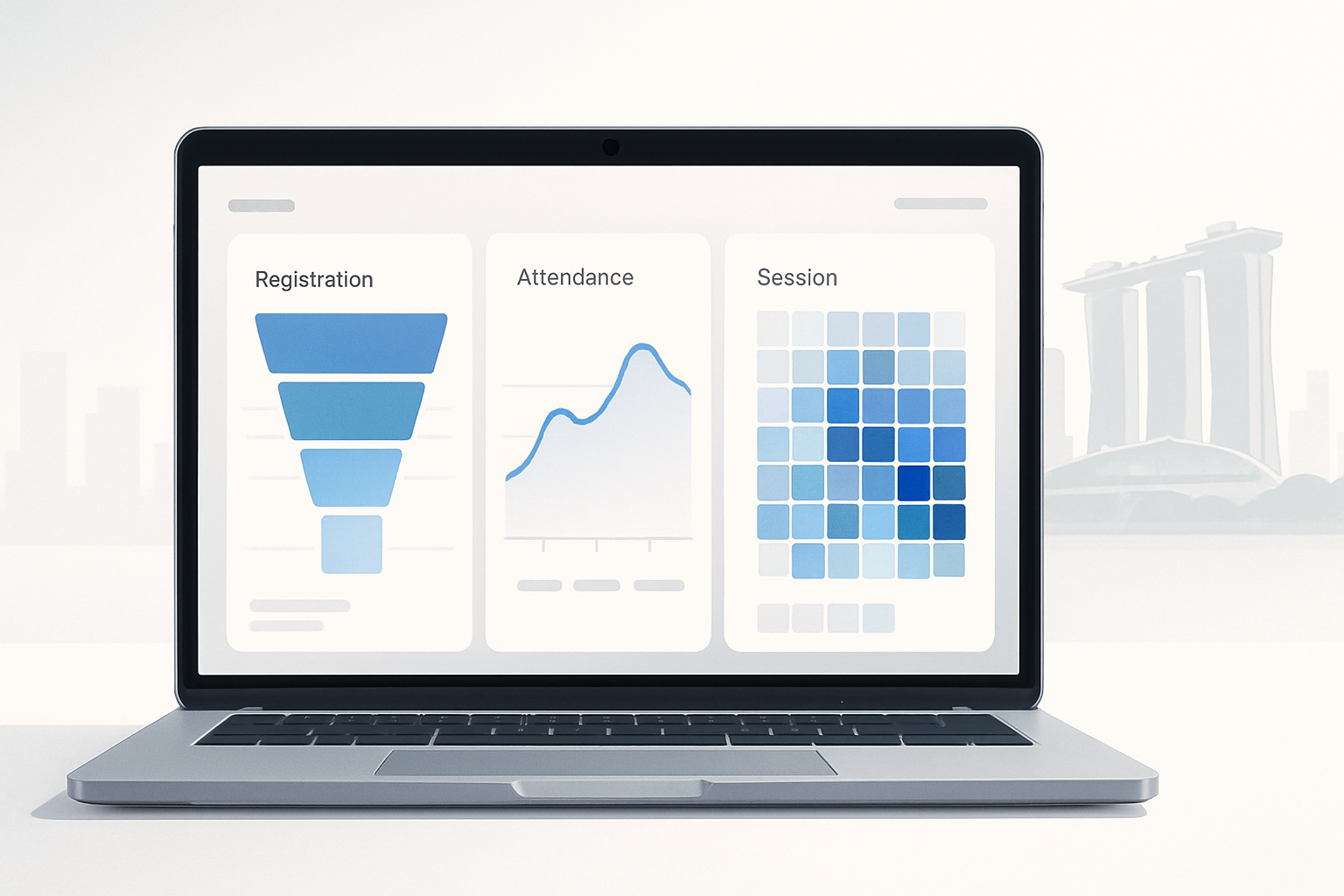
- Analytics and reporting — attendance rates, engagement scores, revenue and ROI dashboards.
The best systems connect these clusters so data flows automatically. A registration, for example, should instantly create an attendee profile, trigger a confirmation email, generate a QR badge and update the revenue dashboard — with no re-keying.
What are the different types of event management systems?
Event management systems generally split into four types by deployment and use case: all-in-one platforms, registration-focused tools, virtual/hybrid platforms and enterprise event management systems. The right type depends on your event scale, budget and technical needs.
| Type | Best for | Typical strengths | Watch-outs |
|---|---|---|---|
| All-in-one platform | Agencies and organisers running varied events | End-to-end coverage, one login, strong reporting | Higher cost; some modules less deep than specialists |
| Registration & ticketing tool | Public events, ticketed shows, meet-ups | Fast setup, low cost, easy checkout | Limited engagement and on-site features |
| Virtual / hybrid platform | Webinars, online summits, hybrid conferences | Streaming, breakouts, on-demand content | Overkill for small in-person events |
| Enterprise event management system | Large corporates, associations, MICE operators | SSO, data governance, multi-event portfolios, APIs | Longer implementation; requires internal ownership |
An online event management system and an event management system online describe the cloud-hosted delivery common to all four types. An enterprise event management system adds the governance layer that large Singapore organisations — banks, government agencies and statutory boards, MNC regional HQs — require: single sign-on, role-based permissions, audit trails and compliance with the Personal Data Protection Act (PDPA).
What is CRM in event management?
CRM in event management refers to integrating a customer relationship management system with your event platform so attendee data becomes part of your ongoing marketing and sales pipeline. Every registration, session attended and survey response enriches the contact record rather than being lost after the event.
This matters because events are among the highest-quality lead sources in B2B marketing. When your EMS syncs with a CRM such as Salesforce, HubSpot or Microsoft Dynamics, sales teams can see exactly which prospects attended, which sessions they joined and how engaged they were — then follow up with context. For Singapore agencies running lead-generation events for clients, this closed loop is often the difference between an event that "went well" and one with a provable return.
What are the 5 stages of event management?
The five stages of event management are research, design, planning, coordination and evaluation — and a good event management system supports every one of them.
- Research — define objectives, audience, budget and format; benchmark past events using historical data in your EMS.
- Design — shape the concept, theme, programme and experience; build the event website and registration flow.
- Planning — lock logistics, vendors, timelines and marketing; automate invitations, reminders and ticketing.
- Coordination — execute on the day; manage check-in, sessions, engagement and live troubleshooting.
- Evaluation — measure attendance, engagement, revenue and satisfaction; report ROI and feed learnings into the next event.
What are the 5 C’s of event management?
The 5 C’s of event management are concept, coordination, control, culmination and closeout — a framework for keeping complex events on track from idea to wrap-up.
- Concept — the "why" and "what": purpose, audience and core idea.
- Coordination — aligning teams, vendors, venues and schedules.
- Control — monitoring budgets, risks and progress against the plan.
- Culmination — the event itself, where preparation meets execution.
- Closeout — settling accounts, thanking stakeholders and analysing outcomes.
An event management system operationalises these principles: coordination lives in shared timelines and task tracking, control lives in budget and registration dashboards, and closeout lives in automated reporting.
How does an event management system benefit Singapore organisers?
An event management system benefits Singapore organisers by cutting manual admin, increasing attendance and turnout accuracy, and producing the data needed to justify event spend — all critical in a market where MICE is a national economic pillar.
Singapore is one of Asia’s leading business-events hubs, consistently ranked among the top international meeting destinations by the ICCA, and events are supported by agencies such as the Singapore Tourism Board (STB) through the Singapore MICE Roadmap. In this environment, professional tooling is expected. Concrete benefits include:
- Time savings — automating registration, reminders and check-in frees teams from repetitive admin.
- Higher attendance — automated reminders and easy mobile check-in reduce no-shows.
- PDPA-ready data handling — reputable systems give consent controls and secure storage aligned with Singapore’s Personal Data Protection Act, overseen by the PDPC.
- Multi-currency and regional reach — SGD plus regional currencies and languages for APAC audiences, with support for local payment rails like PayNow.
- Provable ROI — dashboards translate activity into revenue, leads and engagement metrics.
- Scalability — the same platform serves a 50-person seminar at Marina Bay and a 5,000-delegate conference at Sands Expo & Convention Centre or Suntec Singapore.
What is the best event management system for my needs?
The best event management system is the one that matches your event mix, budget, integration needs and internal capacity — there is no single winner for every organiser. Focus on fit rather than feature count.
Well-known platforms used across Singapore and APAC include Cvent for large enterprise and MICE events, Eventbrite for public and ticketed events, GEVME (a Singapore-founded platform) and Zuddl for virtual and hybrid programmes, Whova for conference apps and networking, and regional business-software suites such as HashMicro and Tigernix for organisations wanting an EMS within a broader ERP. Each excels in a different lane.
Use this checklist when evaluating a best event management system shortlist:
- Does it cover your dominant event format — in-person, virtual or hybrid?
- Can it handle your peak attendee volume without performance issues?
- Does it integrate with your existing CRM, finance and marketing stack?
- Is pricing per-event, per-attendee or subscription — and which suits your cadence?
- Does it support SGD payment gateways (including PayNow) and PDPA-aligned data controls?
- Is local Singapore or regional support available in your time zone (SGT)?
- How steep is the learning curve, and what onboarding is provided?
How much does an event management system cost in Singapore?
Event management system pricing in Singapore typically follows three models — free/freemium, per-attendee or per-ticket fees, and annual subscriptions — and total cost depends heavily on event volume and required features. Note that quoted prices may be subject to GST.
| Pricing model | Typical structure | Best suited to |
|---|---|---|
| Free / freemium | Free for small or free events; fees on paid tickets | Community events, start-ups, one-off gatherings |
| Per-ticket / per-registration | A percentage plus fixed fee per paid registration | Public ticketed events with variable attendance |
| Subscription (SaaS) | Monthly or annual licence, often tiered by features | Organisations running regular events year-round |
| Enterprise licence | Custom annual contract with implementation fees | Large corporates, associations and MICE operators |
Beyond the licence, budget for optional extras such as badge printing hardware, on-site staffing, streaming production for hybrid events, and integration or custom-development work. For agencies, a subscription that spreads across many client events usually delivers the strongest value; for one-off public events, per-ticket pricing keeps costs proportional to revenue.

How do virtual and hybrid event management systems differ?
A virtual event management system delivers the entire experience online — streaming, networking and content on demand — while a hybrid system connects an in-person audience with a remote one through a single platform. The choice shapes your technology, staffing and budget.
Since 2020, hybrid has become the default expectation for many APAC conferences, letting organisers reach regional delegates who cannot travel to Singapore while retaining the value of face-to-face networking. Key considerations:
- Virtual — reliable streaming, engagement tools (polls, chat, Q&A), on-demand libraries and low logistics cost, but higher competition for attention.
- Hybrid — synchronised agendas, dual engagement for both audiences, and stronger sponsor value, but more complex production and higher cost.
- In-person only — richer networking and experience, but capped by venue capacity and travel.
The strongest platforms let you run all three formats from the same attendee database, so a delegate’s data and engagement history stays consistent whichever way they attend.
FAQ
What is the difference between event management software and an event management system?
There is no meaningful difference — the terms are used interchangeably. Both describe a digital platform that handles registration, communications, on-site operations and reporting for events. "System" is often preferred when referring to enterprise-grade, integrated deployments, while "software" is the more general term.
Do I need an event management system for a small event?
Even small events benefit, because automated registration, reminders and check-in save time and reduce no-shows. Many platforms offer free or low-cost tiers for events under a certain size, so you can gain professional tooling without a large budget. The payoff grows as your event frequency and attendee numbers increase.
Is an event management system PDPA compliant?
Reputable event management systems provide the controls needed to comply with Singapore’s Personal Data Protection Act, including consent capture, secure data storage and the ability to delete personal data on request. However, compliance is ultimately the organiser’s responsibility, so you should verify each vendor’s data-handling, hosting location and privacy terms — and check they align with PDPC guidelines — before signing.
Can an event management system handle virtual, hybrid and in-person events?
Yes — most modern platforms support all three formats, and the best ones let you manage them from a single attendee database. This means a delegate attending online has the same profile and engagement record as one attending in person, giving you consistent data and reporting across every format.
How does an event management system integrate with my CRM?
Event management systems integrate with CRMs such as Salesforce, HubSpot and Microsoft Dynamics through native connectors or APIs, syncing registrations, attendance and engagement data into contact records. This lets sales and marketing teams follow up with full context, turning events into a measurable, trackable lead source.
What features should an enterprise event management system have?
An enterprise event management system should offer single sign-on (SSO), role-based access controls, audit trails, multi-event portfolio management, robust APIs and data-residency options that meet governance requirements. These features let large Singapore organisations run many events securely and consistently while maintaining PDPA compliance and central oversight.
How long does it take to implement an event management system?
Simple registration tools can be live within a day, while enterprise event management systems typically take several weeks to a few months, depending on integrations, data migration and staff training. Planning implementation well ahead of your first major event is essential to avoid launching under pressure.
Are there Singapore government grants for event technology?
Singapore SMEs may be able to offset event-technology costs through support schemes such as the Productivity Solutions Grant (PSG) for pre-approved digital solutions, and MICE-specific support offered via the Singapore Tourism Board. Eligibility and pre-approved vendor lists change over time, so check the latest criteria on the GoBusiness and STB websites before purchasing.
Planning your next event with the right system
The right event management system turns fragmented admin into a single, data-driven workflow — and in a competitive MICE market like Singapore, that advantage is measurable in attendance, engagement and ROI. Match the platform to your event mix, integrations and internal capacity rather than chasing the longest feature list.
If you would like help selecting, configuring or running an event management system for your next conference, launch or roadshow, the team at Halo Tech Media works with organisers across Singapore and APAC to deliver seamless event technology end to end. Get in touch with us for a friendly, no-obligation conversation about your goals.
Ready to act on this? Explore our Event Management Platform or book a free consultation.
 Back
Back