
Marketing Automation in Singapore: The Definitive 2025 Guide to Tools, Platforms & Workflows

Marketing automation is software that runs repetitive marketing tasks — emails, WhatsApp messages, lead scoring, ad audiences and journeys — automatically, triggered by customer behaviour. In Singapore it helps lean teams nurture leads across channels, personalise at scale and prove ROI, turning manual campaigns into always-on, data-driven workflows that convert more with less effort.
What is marketing automation, exactly?
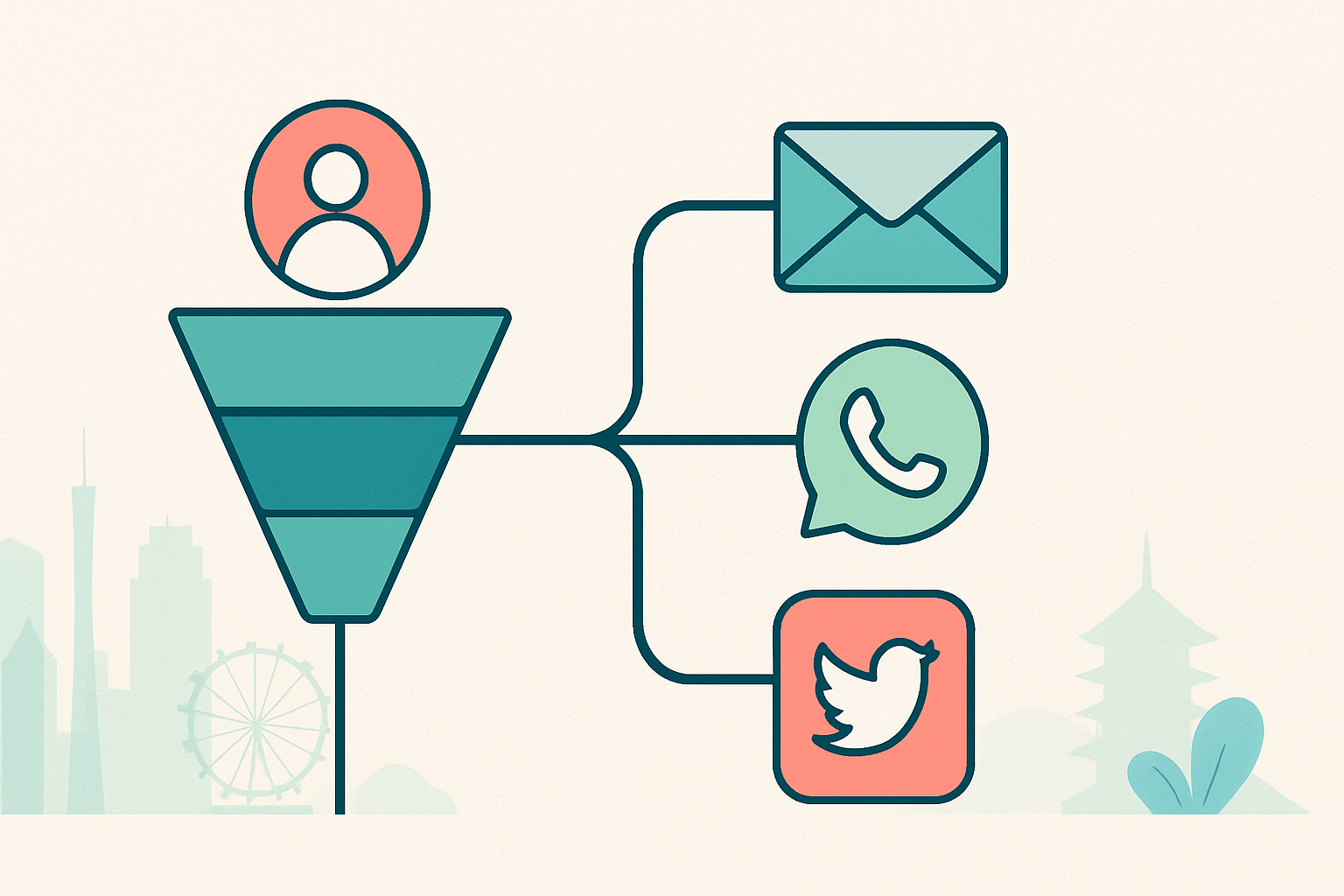
Marketing automation is the use of software to execute, manage and measure marketing tasks and workflows automatically, based on rules and customer behaviour rather than manual effort. The marketing automation definition most practitioners use is deceptively simple: technology that replaces repetitive, time-consuming marketing actions with triggered, personalised sequences.
In practice, that means a new subscriber automatically receives a welcome series, an abandoned cart triggers a reminder, a high-intent lead gets flagged to sales, and a lapsed customer receives a win-back offer — all without anyone pressing "send". The automation marketing definition extends across the entire lifecycle: acquisition, onboarding, nurturing, conversion, retention and re-engagement.
For Singapore businesses juggling small marketing teams and high customer expectations, automation is less a luxury and more the operating system of modern digital marketing automation. It connects your data, content and channels so campaigns respond in real time.
How does marketing automation work?
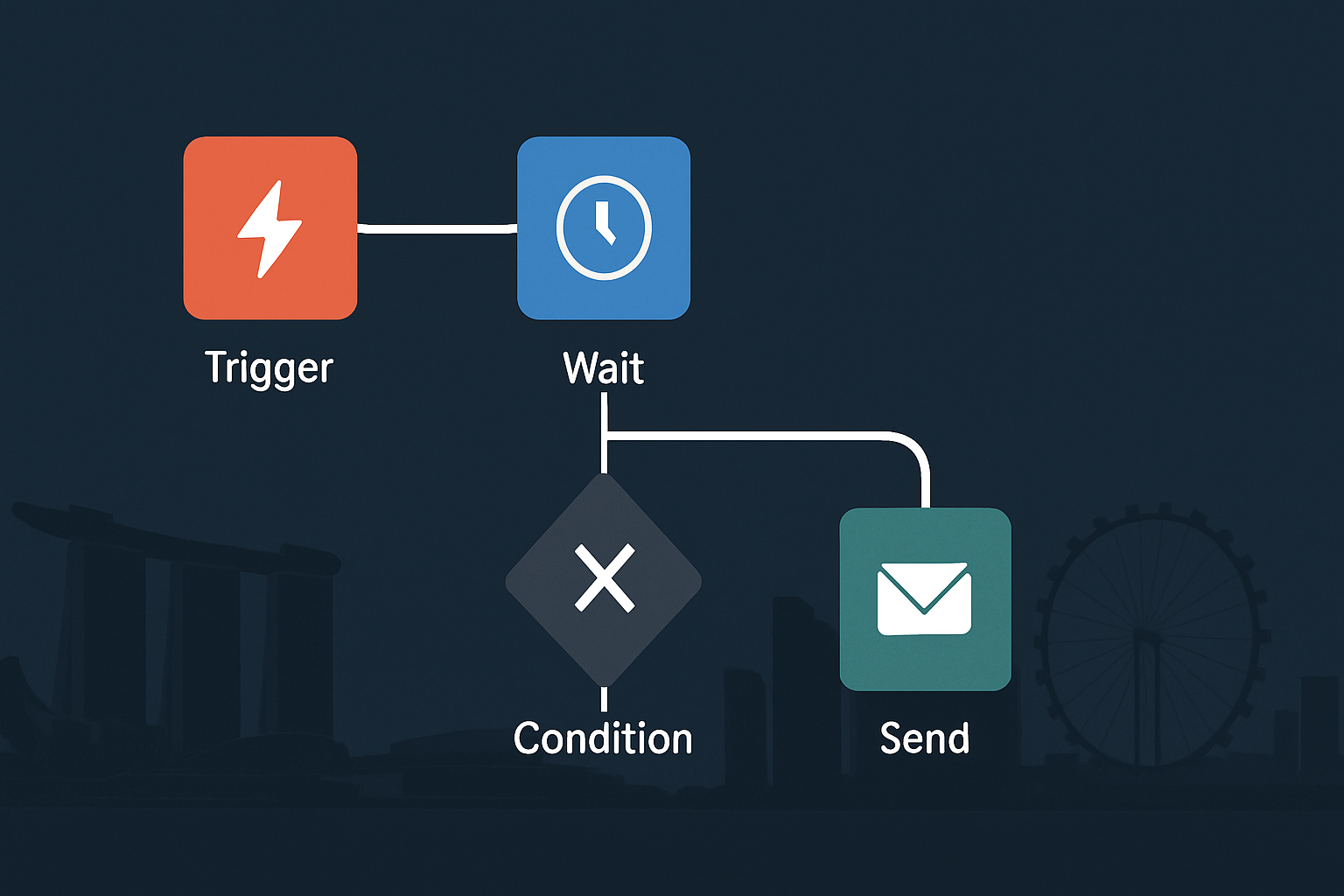
Marketing automation works by combining three ingredients: data (who the customer is and what they do), triggers (events that start an action) and workflows (the sequence of actions that follow). Together they form an "if this, then that" logic engine that runs continuously.
Here is the typical flow inside a marketing automation system:
- Capture — A contact enters via a form, chatbot, WhatsApp opt-in, purchase or ad click.
- Segment — The system tags and groups the contact by attributes and behaviour.
- Trigger — An action (or inaction) fires a rule: opened an email, visited pricing, abandoned checkout.
- Nurture — The contact enters a marketing automation workflow — a branching series of messages timed to their behaviour.
- Score — Engagement adds or subtracts points; hot leads are routed to sales.
- Convert & measure — The platform tracks the outcome and attributes revenue back to the journey.
The magic is in behaviour-based branching. Instead of one linear newsletter, a workflow can send different paths depending on whether someone clicked, purchased or stayed silent — personalisation that would be impossible to run manually at scale.
What are the main types of marketing automation?
The main types are email, omnichannel, CRM-integrated, e-commerce, B2B and B2C automation — each solving a different slice of the customer journey. Most mature Singapore stacks blend several.
- Email marketing automation — The foundation: welcome, nurture, drip and win-back sequences triggered by behaviour. Still the highest-ROI channel for most businesses.
- Omnichannel marketing automation — Coordinates email, SMS, WhatsApp, web push, in-app and social so the customer gets a consistent message across every touchpoint.
- CRM marketing automation — Syncs marketing activity with your sales database so lead scoring, handoffs and follow-ups stay aligned. This underpins true sales and marketing automation.
- E-commerce marketing automation — Cart abandonment, browse abandonment, post-purchase, replenishment and loyalty flows tied to product and order data.
- B2C marketing automation — High-volume, fast-cycle journeys focused on offers, timing and personalisation at scale.
- B2B marketing automation — Longer nurture cycles, lead scoring, account-based sequences and tight sales alignment.
- WhatsApp marketing automation — Increasingly dominant in Singapore and the wider APAC region, using the WhatsApp Business API for opt-in broadcasts, order updates, chatbot flows and conversational commerce.
Why is WhatsApp marketing automation so important in Singapore and APAC?
WhatsApp marketing automation matters enormously in Singapore because WhatsApp is the region’s default messaging channel, with open rates that routinely exceed 90% — far above email. Automating it captures attention where customers already are.
Through the WhatsApp Business API, Singapore brands can automate:
- Opt-in broadcast campaigns and promotions (within Meta’s template and 24-hour session rules).
- Order confirmations, delivery updates and appointment reminders.
- Conversational chatbots that qualify leads, answer FAQs and hand off to a human.
- Two-way re-engagement flows that recover abandoned carts via chat.
Because Singapore’s Personal Data Protection Act (PDPA), enforced by the Personal Data Protection Commission (PDPC), governs consent and the national Do Not Call (DNC) Registry restricts unsolicited messages, WhatsApp automation must be built on explicit opt-in. Done correctly, it becomes the single most powerful channel in an APAC omnichannel stack.
What are the best marketing automation tools and platforms?
The best marketing automation tools depend on your size, channel mix and budget — there is no single winner, but a clear tiering from all-in-one platforms to specialist tools. A marketing automation platform typically bundles email, CRM, landing pages, forms and reporting; a marketing automation tool may focus on one job well.
Here is a comparison of leading marketing automation platforms relevant to Singapore and APAC teams:
| Platform | Best for | Standout strength | Typical SMB pricing (indicative) |
|---|---|---|---|
| HubSpot | B2B & scaling SMBs | Unified CRM + marketing + sales hub | From ~US$20/mo (scales fast) |
| ActiveCampaign | SMBs wanting deep automation | Powerful visual workflow builder | From ~US$15/mo |
| Salesforce Marketing Cloud | Enterprise & complex B2C | Data depth, Journey Builder, AI (Einstein) | Enterprise custom quote |
| Adobe Marketo Engage | Enterprise B2B | Advanced lead scoring & attribution | Enterprise custom quote |
| Zoho Marketing Automation | Cost-conscious SMBs | Value within the Zoho ecosystem | From ~US$19/mo |
| Microsoft Dynamics 365 Customer Insights | Dynamics/Microsoft shops | Native Microsoft & data integration | Enterprise custom quote |
| Dotdigital | Retail & e-commerce | Strong omnichannel + commerce connectors | From ~mid-tier custom |
| Klaviyo | E-commerce (Shopify) | Best-in-class store data & flows | Free tier, usage-based |
ActiveCampaign marketing automation is a favourite among Singapore SMEs for its balance of affordability and genuinely advanced branching. Enterprise brands lean toward Salesforce, Adobe Marketo or Microsoft for data governance and scale. E-commerce merchants on Shopify frequently pair with Klaviyo or Dotdigital.
When evaluating marketing automation software, weigh: channel coverage (email, WhatsApp, SMS, push), native CRM, PDPA-friendly consent management, ease of building workflows, reporting and attribution, integrations (Shopify, Meta, Google), and total cost as your contact list grows.
What is the difference between marketing automation and CRM?
Marketing automation manages and nurtures leads across channels, while a CRM stores and manages customer relationships and sales activity — they overlap but serve different masters. The strongest results come from CRM marketing automation where the two are tightly integrated.
| Dimension | Marketing Automation | CRM |
|---|---|---|
| Primary user | Marketing team | Sales team |
| Core job | Attract, nurture, score leads | Track deals & relationships |
| Data focus | Behavioural & campaign data | Contact & pipeline data |
| Typical trigger | Email opened, page visited | Deal stage changed, call logged |
| Output | Marketing-qualified leads (MQLs) | Closed revenue |
When connected, marketing automation passes sales-ready leads (with a score) into the CRM, and the CRM feeds outcome data back to refine scoring — a closed loop that powers effective sales and marketing automation.
How do lead scoring and workflows drive results?
Lead scoring assigns points to contacts based on who they are and how they behave, so your team focuses on the hottest prospects and automation triggers the right message at the right time. It is the intelligence layer that makes a marketing automation workflow smart rather than blunt.
A simple lead-scoring model might award:
- +10 for visiting the pricing page
- +5 for opening a nurture email
- +15 for downloading a whitepaper
- +20 for requesting a demo
- −10 for 30 days of inactivity
Once a contact crosses a threshold (say 50 points), they’re automatically flagged as an MQL and routed to sales. Below is a starter set of high-impact workflows every Singapore business should run:
- Welcome series — Introduce your brand over 3–5 messages after opt-in.
- Lead nurture — Educate B2B prospects until they’re sales-ready.
- Abandoned cart — Recover lost e-commerce revenue within hours.
- Post-purchase — Onboard, cross-sell and request reviews.
- Re-engagement — Win back dormant contacts before they churn.
- Event follow-up — Automate reminders and post-event nurture (a Halo Tech speciality for Singapore conferences and expos such as those at Marina Bay Sands and Suntec).
What does marketing automation cost in Singapore?
Marketing automation in Singapore ranges from free entry tiers to enterprise contracts, but most SMEs spend between S$50 and S$500 per month on software, plus optional agency or setup fees. Cost scales with your contact list size, feature tier and channel add-ons like WhatsApp.
Budget across three layers:
- Software licence — Usually priced by contacts or emails sent; expect step-ups as your list grows.
- Implementation — One-off setup, migration, integration and workflow build (in-house or via a marketing automation agency).
- Ongoing management — Strategy, content, optimisation and reporting, often delivered as marketing automation services on retainer.
Singapore SMEs may also qualify for support such as the Productivity Solutions Grant (PSG) for pre-approved digital solutions, and the Enterprise Development Grant (EDG), which can offset the cost of adopting qualifying marketing technology — worth checking with Enterprise Singapore (via the GoBusiness portal) before you buy.
What is marketing automation as a service?
Marketing automation as a service is when an agency or provider sets up, runs and optimises your automation platform on your behalf, so you get expert-run workflows without building an in-house team. It combines the software with strategy, content and continuous management.
This model suits Singapore businesses that own a platform but lack the time or specialist skills to build sophisticated journeys. A good marketing automation agency Singapore partner will handle platform selection, PDPA-compliant data setup, workflow design, WhatsApp and email integration, lead scoring, A/B testing and monthly reporting — freeing your team to focus on offers and products.
What does a marketing automation case study look like?
A strong marketing automation case study shows a measurable before-and-after: more qualified leads, higher conversion, recovered revenue or hours saved. The best proof points tie a specific workflow to a concrete business outcome.
Illustrative results Singapore teams commonly achieve:
- A B2B firm adds lead scoring and nurture, lifting MQL-to-SQL conversion by 30–40% while cutting manual follow-up time.
- An e-commerce brand deploys cart-abandonment and browse flows, recovering 10–15% of otherwise-lost checkouts.
- An events organiser automates WhatsApp and email reminders, boosting attendance and slashing no-shows.
When reviewing any vendor or agency, ask for case studies with named metrics, the platform used, and the timeframe — vague claims are a red flag.
How do you implement marketing automation? A step-by-step approach
You implement marketing automation by defining goals, cleaning your data, choosing a platform, mapping journeys, building workflows and then continuously measuring and refining. Skipping the strategy stage is the most common reason implementations fail.
- Set clear goals — Tie automation to revenue, lead volume or retention targets.
- Audit and clean your data — Garbage in, garbage out; ensure PDPA-compliant consent records.
- Map the customer journey — Identify key moments where automation adds value.
- Choose the right platform — Match features to your size, channels and budget.
- Build foundational workflows — Start with welcome, nurture and cart-recovery flows.
- Add lead scoring and CRM sync — Align marketing and sales handoffs.
- Test, measure and optimise — Use A/B testing and analytics to improve continuously.

What skills does a marketing automation specialist need?
A marketing automation specialist needs a blend of technical, analytical and creative skills — from building workflows and managing data to writing copy and reading reports. The role sits at the intersection of marketing, data and technology.
Core competencies include:
- Platform expertise — Mastery of tools like HubSpot, ActiveCampaign or Salesforce.
- Workflow logic — Designing branching, triggers and lead-scoring models.
- Data management — Segmentation, list hygiene and PDPA compliance.
- Copywriting — Persuasive email, WhatsApp and landing-page content.
- Analytics — Interpreting open rates, conversions and attribution.
- CRM and integration — Connecting the martech stack.
For many Singapore SMEs, hiring and retaining this talent is harder than buying software — which is why partnering with a specialist agency is often the faster route to results.
Frequently asked questions
What is marketing automation in simple terms?
Marketing automation is software that automatically performs marketing tasks — such as sending emails, WhatsApp messages and social posts — based on customer behaviour and predefined rules, so your marketing runs consistently without constant manual effort.
What are the best marketing automation tools for small businesses in Singapore?
For most Singapore SMEs, ActiveCampaign, HubSpot and Zoho Marketing Automation offer the best balance of affordability, powerful workflows and ease of use, while Klaviyo and Dotdigital are strong choices for e-commerce brands.
Is WhatsApp marketing automation legal in Singapore?
Yes, WhatsApp marketing automation is legal in Singapore provided you obtain explicit opt-in consent, respect the Personal Data Protection Act (PDPA) and the Do Not Call Registry, and use the official WhatsApp Business API within Meta’s messaging policies.
What is the difference between email marketing and marketing automation?
Email marketing sends campaigns to lists, while marketing automation triggers personalised sequences based on individual behaviour across multiple channels; email is one channel within the broader automation system.
How much does marketing automation cost in Singapore?
Marketing automation software typically costs between S$50 and S$500 per month for SMEs depending on contact volume and features, with additional one-off implementation and optional agency management fees; PSG or EDG grants may offset costs for eligible Singapore SMEs.
Do I need a CRM to use marketing automation?
You do not strictly need a separate CRM, as many platforms include built-in contact management, but integrating a CRM greatly improves lead scoring, sales handoffs and revenue attribution for sales and marketing automation.
Can marketing automation work for both B2B and B2C?
Yes, marketing automation works for both; B2B focuses on longer nurture cycles and lead scoring, while B2C emphasises high-volume, real-time personalised offers — most platforms support either model.
What is omnichannel marketing automation?
Omnichannel marketing automation coordinates messaging across email, SMS, WhatsApp, web push, social and in-app so customers receive a consistent, connected experience regardless of which channel they use.
Which grants can help Singapore SMEs pay for marketing automation?
Singapore SMEs can tap the Productivity Solutions Grant (PSG) for pre-approved digital marketing solutions and the Enterprise Development Grant (EDG) for larger transformation projects; eligibility and support levels are set by Enterprise Singapore and can be applied for via the GoBusiness portal.
Ready to automate your marketing the right way?
Marketing automation rewards those who combine the right platform with a clear strategy, clean data and channels your customers actually use — especially WhatsApp and email in the Singapore and APAC market. Whether you’re choosing your first tool, building smarter workflows or want your automation run for you as a service, Halo Tech Media can help. Get in touch with our team for a friendly, no-obligation chat about your marketing automation roadmap.
2149
Further reading: Email Marketing in Singapore: The Complete 2026 Guide to Services, Software, Costs & Strategy
 Back
Back