
Programmatic Ads Singapore: The Complete 2025 Guide to Programmatic Advertising

Programmatic advertising in Singapore is the automated, data-driven buying of digital ad space — across display, video, audio, native and digital billboards — using real-time bidding to place each impression in front of the right person, at the right moment, at the right price. It replaces manual media negotiation with software, precision targeting and continuous optimisation.
That single shift — from human haggling to machine buying — now underpins the majority of digital display spend in Singapore and across APAC. This pillar guide explains how programmatic works, the platforms and formats involved, how programmatic billboards (DOOH) operate along Orchard Road and the CBD, what campaigns cost in SGD, and how to choose a programmatic advertising agency in Singapore that actually moves your numbers.
What Are Programmatic Ads?
Programmatic ads are digital advertisements bought and sold automatically through technology platforms rather than through manual insertion orders. Instead of a media buyer emailing a publisher to negotiate a fixed rate, algorithms evaluate each available impression in milliseconds and decide whether to bid, how much to bid, and which creative to serve.
The result is advertising that is faster to launch, more precisely targeted, and continuously optimised against real performance data. For Singapore brands competing in a crowded, digitally mature market — where internet penetration exceeds 96% and mobile is the dominant screen — programmatic gives you scale and precision that manual buying simply cannot match.
Programmatic spans nearly every channel a modern audience touches:
- Display — banners on websites and apps
- Video — pre-roll, mid-roll, post-roll and out-stream, including OTT and connected TV
- Native — ads that match the look and feel of surrounding content
- Audio — streaming music, podcasts and digital radio
- Digital out-of-home (DOOH) — programmatic billboards and screens in public spaces
How Does Programmatic Advertising Work?
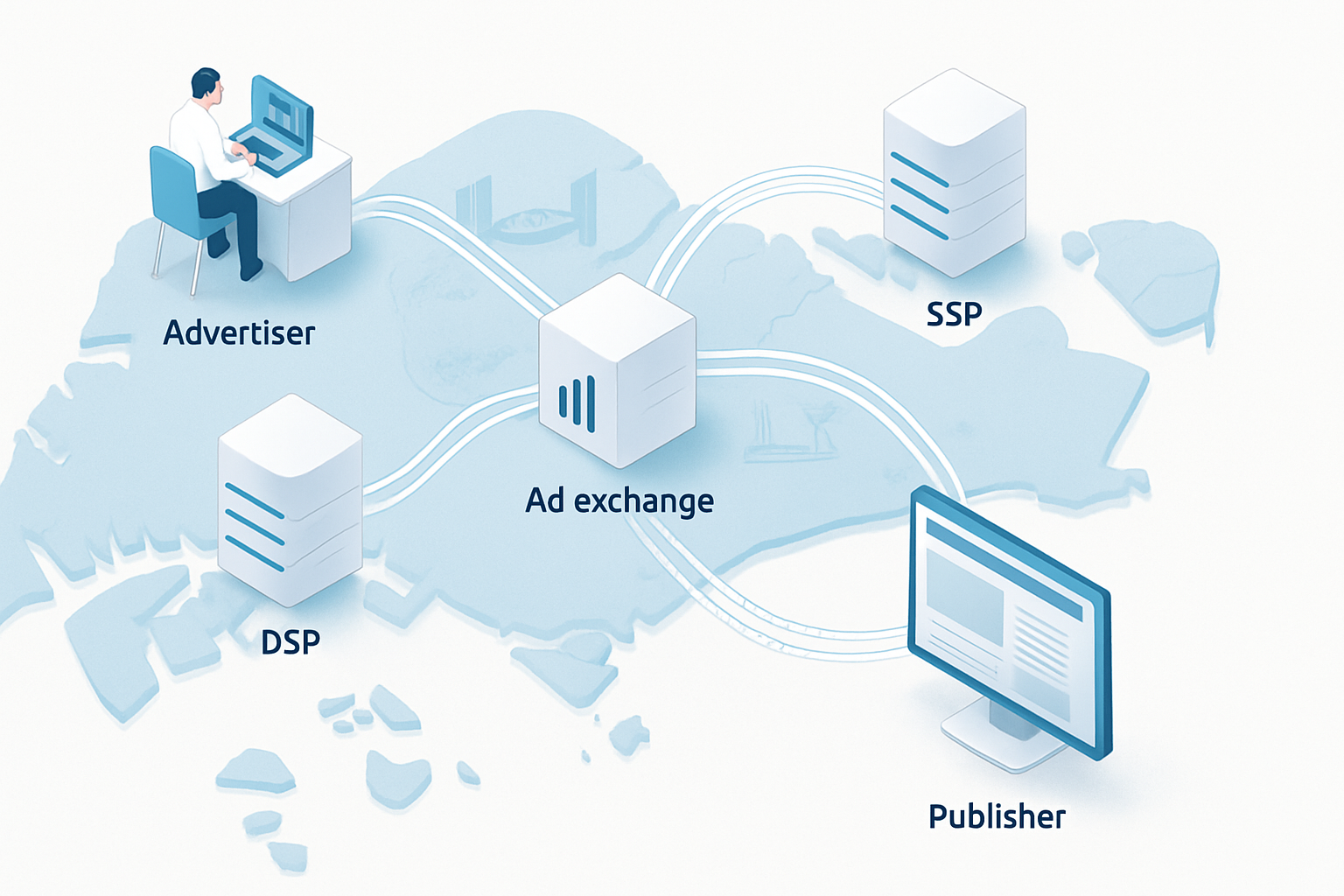
Programmatic advertising works by running an automated real-time auction for every ad impression the instant a page or app loads. The entire process — from a user opening a website to the winning ad appearing — completes in under 100 milliseconds.
Here is the sequence behind each impression:
- A user loads a page or app. The publisher’s available ad slot is passed to a supply-side platform (SSP).
- The impression is offered to an ad exchange. This is the marketplace where buyers and sellers meet.
- Advertisers bid via a demand-side platform (DSP). The DSP evaluates the user’s profile, location, device, time of day and campaign goals, then submits a bid.
- Real-time bidding (RTB) selects a winner. The highest suitable bid wins the impression.
- The ad is served instantly. The winning creative — often personalised through dynamic creative optimisation (DCO) — appears as the page finishes loading.
Data management platforms (DMPs) and customer data platforms (CDPs) enrich this process by supplying audience segments, while measurement partners verify viewability, brand safety and fraud.
The Core Platforms Explained
| Platform | Who Uses It | What It Does |
|---|---|---|
| DSP (Demand-Side Platform) | Advertisers & agencies | Automates buying and bidding across multiple exchanges (e.g. DV360, The Trade Desk, Amazon DSP) |
| SSP (Supply-Side Platform) | Publishers | Manages and sells ad inventory to the highest bidder |
| Ad Exchange | Both sides | The digital marketplace where impressions are auctioned |
| DMP / CDP | Advertisers | Stores and segments first- and third-party audience data |
| DOOH SSP | Screen owners | Makes billboard and screen inventory available programmatically |
What Types of Programmatic Buying Are There?
There are four main ways to buy programmatically, ranging from fully open auctions to fixed, guaranteed deals. Choosing the right type balances reach, control and price.
- Open Real-Time Bidding (Open RTB): Inventory is auctioned to any buyer. Highest reach, lowest cost, least control over placement.
- Private Marketplace (PMP): An invitation-only auction where select advertisers bid on premium inventory. Better quality and brand safety.
- Preferred Deals: A fixed price is agreed with a publisher, but the advertiser is not obligated to buy every impression.
- Programmatic Guaranteed (PG): Reserved inventory at a fixed price and volume — the closest thing to traditional direct buying, with programmatic efficiency. This is now the dominant model for premium and DOOH placements in Singapore.
What Ad Formats Can You Run Programmatically?
Programmatic supports every major digital format, letting you build full-funnel campaigns from a single strategy. The best-performing Singapore campaigns typically combine two or three formats to reinforce a message across screens.
- Banner / display ads — cost-effective, always-on visibility for awareness and retargeting across websites and apps.
- Video ads — high-impact storytelling via YouTube, OTT and publisher sites; strong for brand recall and consideration.
- Native ads — non-intrusive placements that blend into editorial content, distributed via networks such as Outbrain and Taboola; ideal for content and thought-leadership promotion.
- Audio ads — reach commuters and multitaskers on Spotify, podcasts and digital radio during screen-free moments, including the daily MRT commute.
- Digital out-of-home (DOOH) — programmatic billboards and screens that bring the precision of digital buying to physical spaces.

Programmatic sits comfortably alongside your other paid channels. Many Singapore brands pair it with campaigns on core social platforms — from Facebook ads services to TikTok ads — using programmatic display and DOOH to extend reach and retarget audiences beyond the walled gardens.
How Do Programmatic Billboard Ads Work in Singapore?
Programmatic billboard ads in Singapore — known as programmatic digital out-of-home (pDOOH) — apply real-time, data-driven buying to physical digital screens, so brands can trigger or target billboard placements automatically rather than booking fixed 4-week panels.
Instead of committing to a single static billboard for a month, advertisers buy screen time through a DSP connected to a DOOH SSP. Impressions on screens along Orchard Road, in Raffles Place, at Changi Airport, inside shopping malls (such as ION Orchard, VivoCity and Jewel), and across the MRT and bus network can be bought by the play, targeted by location, daypart and audience movement patterns.
What makes programmatic DOOH powerful in the Singapore context:
- Contextual triggers — serve creative based on weather (e.g. an aircon or cold-drink promotion when temperatures spike, or an umbrella offer during a downpour), time of day, or live data feeds.
- Audience-based buying — screens are selected using mobility and telco data indicating when a target audience is likely to pass by.
- Flexible budgets — no month-long lock-ins; scale spend up or down in real time.
- Cross-channel retargeting — mobile users exposed to a billboard can later be retargeted with display or video ads, closing the online-to-offline loop.
Singapore is one of APAC’s most advanced DOOH markets thanks to its dense urban footprint, high screen availability and strong smart-nation digital infrastructure — making pDOOH especially effective here compared with more fragmented regional markets. To run this well, most brands work with a specialist partner such as a dedicated programmatic advertising agency in Singapore that can connect DSPs to local DOOH inventory.
Why Should Singapore Businesses Use Programmatic Advertising?
Singapore businesses should use programmatic advertising because it delivers precise audience targeting, efficient budget use, real-time optimisation and measurable results — advantages that manual media buying cannot match in a fast-moving, mobile-first market.
Reach the right audience. Combine demographic, behavioural, contextual and third-party data to show ads to relevant users — not just more users. You can target by district (e.g. CBD vs heartland), language (English, Mandarin, Malay or Tamil), device, interest and purchase intent.
Cost efficiency. With real-time bidding you only compete for impressions matching your criteria, cutting wasted spend on low-value placements. Budgets can be reallocated on the fly toward what is working.
Data-driven decisions. Every impression, click, conversion and engagement is tracked in real time, revealing which audiences, creatives and placements perform best.
Continuous optimisation. Bids, targeting, placements and creatives can be adjusted throughout the flight to protect and improve return on ad spend (ROAS).
Full-funnel versatility. One strategy can span display, video, audio, native and DOOH — from first impression to final conversion. For B2B advertisers in particular, programmatic complements account-based tactics such as LinkedIn ads for B2B to keep target accounts warm across multiple touchpoints.
How Much Do Programmatic Ads Cost in Singapore?
Programmatic advertising in Singapore is typically priced on a CPM (cost per thousand impressions) basis, with rates varying by format, targeting precision and inventory quality. Most brands allocate a working media budget plus an agency management fee or platform margin.
| Format | Typical CPM Range (SGD) | Best For |
|---|---|---|
| Display / banner | S$2 – S$8 | Awareness, retargeting, always-on reach |
| Native | S$5 – S$15 | Content promotion, engagement |
| Online video / OTT | S$15 – S$45 | Brand building, consideration |
| Audio | S$8 – S$20 | Screen-free reach, recall |
| Programmatic DOOH | S$8 – S$30 | High-impact visibility, location targeting |
Ranges are indicative and vary with targeting complexity, PMP/PG deals and campaign scale. Premium, brand-safe or highly targeted inventory sits at the higher end.
A practical starting budget for a meaningful multi-format test in Singapore is often in the range of S$5,000–S$15,000 per month, though DOOH-led or national campaigns require more. The key is matching spend to a clear objective — awareness, leads or sales — rather than to a format.
How Do You Measure Programmatic Campaign Success?
You measure programmatic success against objectives using a layered set of metrics — from delivery to business outcomes — rather than any single number. The right KPI depends on where the campaign sits in the funnel.
- Delivery & quality: impressions, viewability rate, completion rate (video), brand safety and invalid traffic (fraud) rates.
- Engagement: click-through rate (CTR), video quartile completions, audio listen-through.
- Efficiency: CPM, CPC, cost per completed view, cost per acquisition (CPA).
- Outcomes: conversions, ROAS, incremental lift, footfall lift (for DOOH via mobile attribution).
Transparent reporting is non-negotiable. A strong agency provides dashboards, regular readouts and actionable recommendations so you always understand where every dollar goes — and what it returns.
What Should You Look For in a Programmatic Advertising Agency in Singapore?
Look for a programmatic advertising agency in Singapore that pairs platform expertise with transparent reporting, local audience knowledge and a clear, objective-led strategy — not just access to a DSP.
Key criteria when comparing programmatic agencies and companies:
- Platform access & certification — proven experience with leading DSPs such as DV360 and The Trade Desk.
- Transparency — clear fees, media margins and full-funnel reporting; no black-box spend.
- Audience targeting solutions — first-party data activation, DMP/CDP integration and privacy-compliant segmentation.
- Creative capability — dynamic creative optimisation (DCO) to personalise messaging at scale.
- Local & regional reach — knowledge of Singapore inventory plus the ability to extend campaigns across Malaysia and wider APAC.
- Brand safety & fraud controls — verification partnerships and PMP/PG options for premium environments.
A capable programmatic advertising partner in Singapore should also help you connect these campaigns to the rest of your marketing mix, from SEO services to your wider social media marketing programme, so every channel reinforces the same objectives.

How Does Programmatic Advertising Handle Data Privacy?
Programmatic advertising in Singapore must comply with the Personal Data Protection Act (PDPA), enforced by the Personal Data Protection Commission (PDPC), which governs how personal data is collected, used and disclosed. As third-party cookies decline, the industry is shifting toward privacy-first targeting.
Modern, compliant approaches include:
- First-party data — your own CRM and website audiences, activated securely via a CDP.
- Contextual targeting — matching ads to page content rather than personal identity.
- Cohort and interest-based signals — grouping audiences without individual tracking.
- Consent management — clear opt-ins aligned with PDPA obligations, including Do Not Call (DNC) considerations where relevant.
Working with a knowledgeable agency ensures your programmatic activity remains both effective and compliant as regulations and browser policies evolve. Because major platforms continue to update their privacy and measurement tooling, it is worth reviewing official resources such as Google’s advertising and Privacy Sandbox documentation as browser policies change.
Frequently Asked Questions
What is the difference between programmatic advertising and Google Ads?
Google Ads is one channel that uses programmatic principles within Google’s own ecosystem (Search, Display, YouTube). Broader programmatic advertising, run through a DSP such as DV360 or The Trade Desk, buys inventory across thousands of exchanges, publishers, apps and DOOH screens — giving far wider reach and more granular control than a single platform.
Is programmatic advertising worth it for small businesses and SMEs in Singapore?
Yes, programmatic advertising can work for smaller Singapore businesses and SMEs provided the campaign has a clear objective and a realistic budget. Because bidding is efficient and targeting is precise, even modest budgets can reach highly relevant local audiences and be optimised continuously, though a managed-service agency is usually the most cost-effective route for smaller teams. Some SMEs may also be able to offset digital marketing costs through support schemes listed on GoBusiness or via grants administered by Enterprise Singapore where eligible.
What are programmatic billboard ads?
Programmatic billboard ads, or programmatic digital out-of-home (pDOOH), are digital screen placements bought automatically through a DSP rather than booked as fixed panels. In Singapore, they let advertisers target screens along Orchard Road, in malls, at Changi Airport and across MRT and bus transit by location, time and audience movement, with flexible, real-time budgeting.
How quickly can a programmatic campaign go live?
A programmatic campaign can typically launch within a few business days once creative assets, targeting parameters and tracking are ready. Complex campaigns involving DOOH, PMP deals or custom audience integrations may take one to two weeks to set up properly.
Which platforms are used for programmatic advertising?
The most widely used demand-side platforms include Google Display & Video 360 (DV360), The Trade Desk and Amazon DSP, alongside SSPs, ad exchanges and specialist DOOH platforms. Agencies select platforms based on the channels, inventory and audiences a campaign requires.
Can programmatic advertising reach audiences across APAC and Malaysia?
Yes, programmatic advertising scales easily beyond Singapore. Because DSPs connect to global and regional inventory, a single campaign can extend into Malaysia, Indonesia and wider APAC with localised targeting, language and creative — making it ideal for Singapore brands with regional growth ambitions.
What is dynamic creative optimisation (DCO)?
Dynamic creative optimisation automatically assembles and adjusts ad creative — visuals, messaging and calls to action — based on each user’s data and behaviour. This personalisation improves relevance and typically lifts engagement and conversion rates compared with a single static creative.
How does programmatic advertising reduce wasted ad spend?
Programmatic reduces waste by bidding only on impressions that match your defined audience and by optimising in real time toward the placements, times and creatives that perform. Instead of paying a fixed rate for broad exposure, you pay competitively for relevant reach.
Is programmatic advertising PDPA-compliant in Singapore?
Yes, when run correctly. Programmatic activity in Singapore should follow the Personal Data Protection Act (PDPA), relying on consented first-party data, contextual targeting and privacy-first segmentation rather than intrusive individual tracking. A reputable local agency will ensure consent management and data handling meet PDPC requirements.
Ready to Launch Smarter Programmatic Campaigns?
Programmatic advertising rewards strategy, clean data and relentless optimisation — and that is exactly where a specialist partner earns its keep. At Halo Tech Media, we help Singapore and APAC brands plan, launch and optimise programmatic campaigns across display, video, native, audio and programmatic DOOH, all built around clear objectives and transparent, measurable results.
If you would like to explore how programmatic ads could work for your brand, get in touch with the team at Halo Tech Media — we would be glad to map out a strategy tailored to your goals.
 Back
Back