
Google’s Latest AI Overviews Upgrade: A Win for Users, Publishers, and Brands?
Google’s 2026 AI Overviews upgrade (announced at Google I/O) changes how people find information — AI now summarises answers directly and introduces background search agents. For brands, the stakes of being the cited source have never been higher.
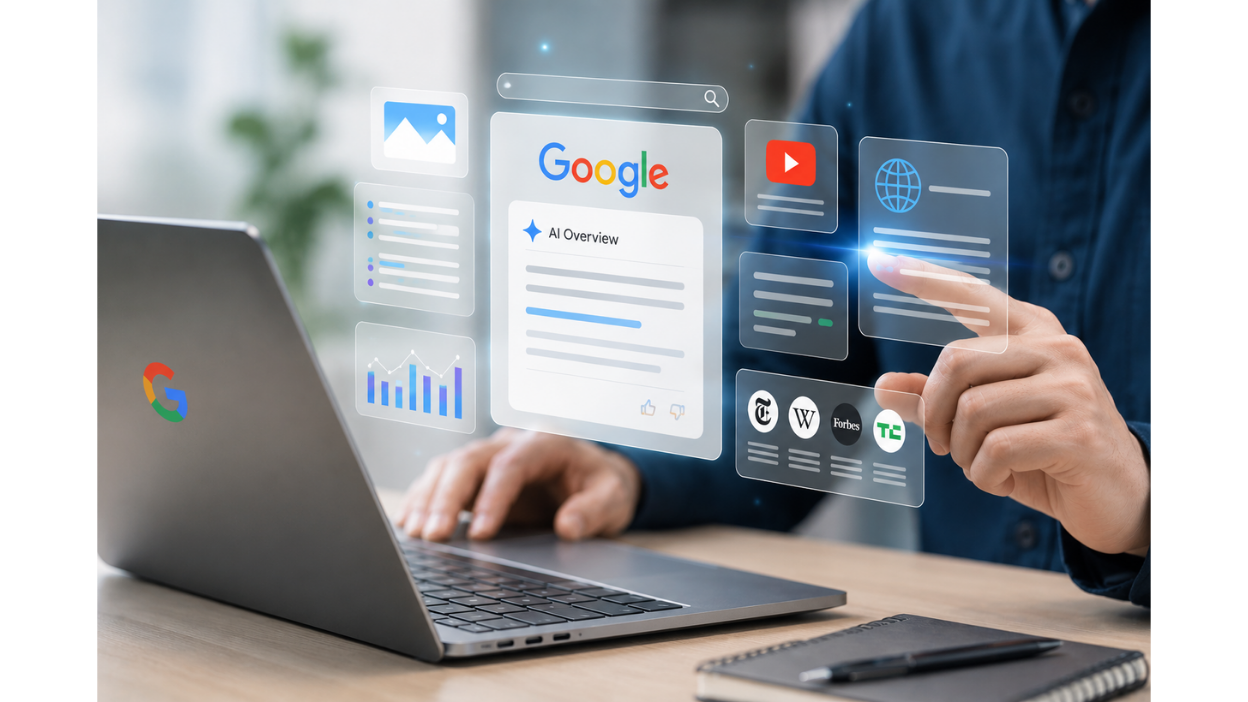
The digital landscape experienced a seismic shift during the Google I/O 2026 event. Specifically, the tech giant announced changes that redefine how humans interact with information online. For decades, typing a few keywords into a simple white box was the global standard for finding answers. However, that era is officially drawing to a close. During the May 2026 keynote, Google unveiled its most significant Search upgrade in over 25 years. This transformation is driven by the introduction of the agentic Gemini era, completely overhauling the traditional search experience. Consequently, marketers, content creators, and everyday web surfers are wondering how these monumental updates will impact their daily digital lives.
Google’s vision is no longer limited to indexing static blue links. Instead, the focus has shifted toward conversational discovery, multimodal inputs, and highly capable AI agents that perform tasks on behalf of users. Therefore, it is crucial to analyze whether these groundbreaking features truly represent a collective victory for the entire online ecosystem. We will dive deep into the mechanics of Google’s latest AI Overviews, explore the rise of background-running Search agents, and examine what this means for users, publishers, and brands.
The Core Updates: Gemini 3.5 Flash and the Intelligent Search Box
First, we must examine the engine powering this revolution. Google has officially made Gemini 3.5 Flash the default model for its AI Mode globally. This particular model delivers frontier-level performance, optimized specifically for low latency and high-speed reasoning. Thus, users no longer have to wait awkwardly for an AI to generate a helpful summary. The answers appear almost instantaneously.
Furthermore, the classic Search box has been entirely reimagined. The newly designed interface expands dynamically to accommodate complex, multi-layered queries. Users are no longer restricted to text. They can drop images, video files, and even open Chrome tabs directly into the search bar. Imagine trying to fix a broken bicycle chain. Instead of typing “how to fix a bike chain,” you can simply upload a quick video of the jammed gears. The AI will immediately analyze the visual data, identify the specific derailleur model, and provide a step-by-step troubleshooting guide.
This level of multimodal integration is unprecedented. As Sundar Pichai noted during the keynote, the AI Overviews feature has already surpassed 2.5 billion monthly active users. Clearly, the public is hungry for dynamic, intelligent responses rather than a tedious list of website links.
The Dawn of AI Agents: Search That Works for You
Perhaps the most thrilling announcement from Google I/O 2026 was the introduction of Search agents. These digital assistants operate in the background to handle complex workflows. Previously, an AI could summarize a recipe for you. Now, a Search agent can read that recipe, cross-reference it with your known dietary restrictions, add the missing ingredients to your digital shopping cart, and schedule a grocery delivery.
Google is facilitating this through an open web standard called WebMCP. This framework allows websites to expose structured tools—like HTML forms and JavaScript functions—directly to browser-based agents. Consequently, an agent can interact with a site’s interface with extreme precision. The internet is transitioning from a repository of documents to a toolkit of actions.
Although this sounds like science fiction, it is rolling out right now. Users can connect their personal ecosystems, including Gmail and Google Photos, to this new AI Mode. Thus, the search engine becomes an omniscient personal assistant that understands context, schedule, and historical preferences.
A Win for Users?
Without a doubt, everyday searchers are the most obvious beneficiaries of this upgrade. The modern web had become increasingly cluttered with intrusive advertisements, search-engine-optimized fluff, and aggressive pop-ups. Users often had to dig through thousands of words just to find a simple recipe measurement or a quick software fix.
The new AI Overviews eliminate this friction entirely. Information is instantly curated, summarized, and presented in a highly digestible format. Furthermore, the ability to converse naturally with the search engine removes the burden of “keyword guessing.” If a user does not understand a specific concept, they can simply ask the AI to simplify the explanation. Therefore, the user experience is significantly faster, richer, and far more intuitive than ever before.
A Win for Publishers?
The situation is distinctly more complicated for publishers and media outlets. Traditional Search Engine Optimization (SEO) relied heavily on capturing keyword volume to drive massive amounts of superficial traffic. However, the new AI Mode often answers the user’s question directly on the results page. Consequently, click-through rates for informational queries will inevitably decline. Industry analysts suggest that thin, keyword-stuffed content will become entirely obsolete.
Nevertheless, there is a silver lining for high-quality publishers. The AI agent requires fresh, accurate, and structured data to function correctly. Static pages that have not been updated in years will be ignored. Conversely, newsrooms and content hubs that prioritize real-time updates, original reporting, and entity-rich passages will become the primary citations for Google’s AI models. The game has shifted from SEO to Generative Engine Optimization (GEO). Publishers must now focus on building topical authority and implementing flawless schema markup. Thus, websites that genuinely add unique value will thrive, while those that merely aggregate information will fade away.
A Win for Brands?
For brands and e-commerce platforms, the agentic web presents an extraordinary opportunity. The introduction of Universal Cart and agent-driven shopping means that the buying journey is drastically compressed. When a user asks Google to find “the best running shoes for flat feet under $150,” the AI agent will not just list review articles. It will actively compare inventory across multiple retailers, check available sizes, and present direct purchase options.
Brands that optimize their digital storefronts for WebMCP will gain a massive competitive advantage. If your website allows Google’s agents to seamlessly access inventory data and execute transactions, you will capture sales effortlessly. Therefore, visibility is no longer just about ranking; it is about being readily accessible to machine-learning models.
The Verdict
Google’s I/O 2026 announcements confirm that the era of the agentic web is fully upon us. Is this upgrade a universal win? For users, it is a resounding triumph of convenience and clarity. For publishers, it is a demanding trial by fire that will separate true journalists from content farmers. For brands, it is an unprecedented opportunity to connect with consumers exactly at the point of intent.
The fundamental truth is that you cannot fight the algorithm. The shift toward multimodal, agent-driven search is permanent. Therefore, businesses must adapt their digital architecture to communicate effectively with artificial intelligence. The websites of tomorrow must be built for both human eyes and machine reasoning.
Future-Proof Your Business with Halo Tech Media
Halo Tech Media specializes in preparing businesses for the AI-first future. We offer comprehensive GEO audits, advanced structured data implementation, and strategic content planning tailored specifically for Google’s latest search algorithms. Do not let your competitors claim the top spot in the new AI Overviews. Reach out to the experts who understand exactly how these intelligent agents think, operate, and make recommendations.
Contact Halo Tech Media today to schedule a consultation.
Together, we will transform your website into an authoritative, agent-friendly powerhouse that dominates the next generation of Search.
References
- Google Search’s I/O 2026 updates: AI agents and more
- I/O 2026: Welcome to the agentic Gemini era
- Google I/O 2026 Recap: SEO and GEO Implications
Frequently Asked Questions
What changed in Google's 2026 AI Overviews upgrade?
Google expanded AI Overviews with more capable AI summaries and background search agents announced at Google I/O 2026, further shifting search from a list of links toward direct, AI-generated answers.
How do AI Overviews affect brands and publishers?
AI Overviews answer more queries on the results page, increasing zero-click searches. Visibility now depends on being the trusted source the AI cites, not just ranking in the blue links.
How do you get cited in Google AI Overviews?
Publish clear, answer-first, authoritative content with strong E-E-A-T and structured data, cover topics comprehensively, and earn trust signals — the same foundations as Generative Engine Optimization (GEO).
 Back
Back