
TikTok Shop vs. Social Commerce: Which Platform Offers Better Margins in 2026?
TikTok Shop offers in-app checkout and viral discovery but comes with platform fees and margin pressure, while broader social commerce spreads risk across channels. Which delivers better margins in 2026 depends on your product, fee structure and customer acquisition cost.
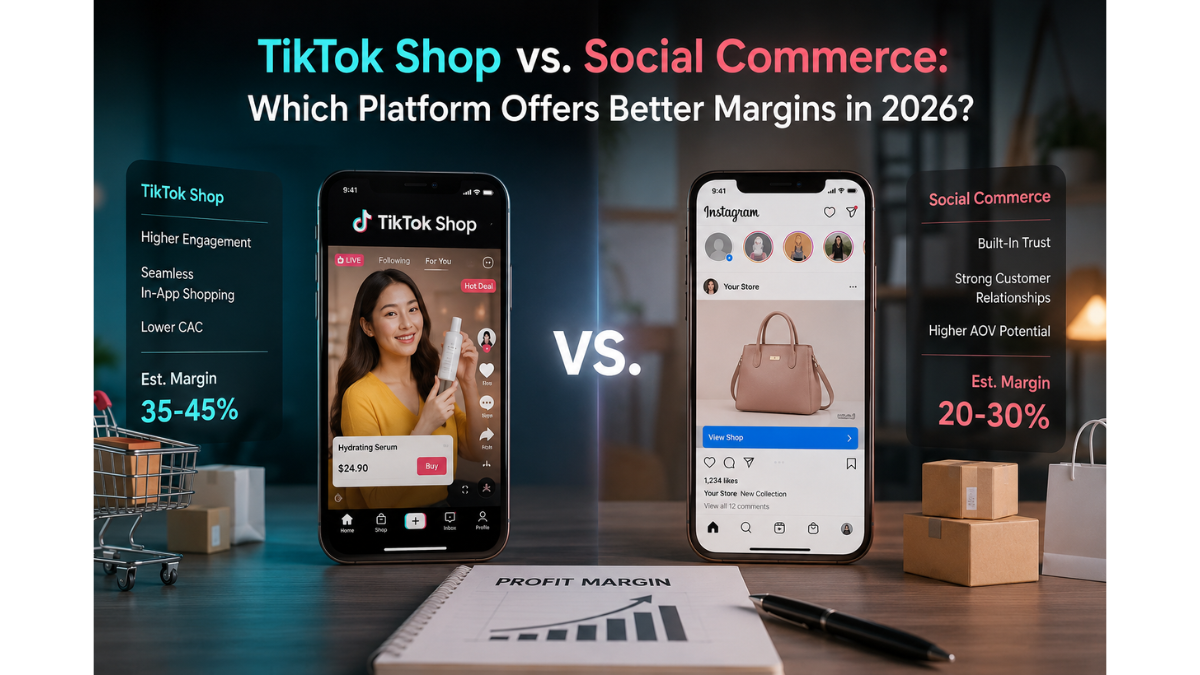
Waking up to a relentless barrage of notification pings, signaling that your latest product video just went astronomically viral, represents the ultimate e-commerce fantasy. Consequently, your inventory is entirely sold out before your morning coffee is even brewed. Although this scenario sounds incredibly lucrative, the post-viral financial autopsy often tells a remarkably different story. Hence, many merchants rapidly realize that a massive explosion in gross merchandise volume does not automatically translate into a healthy bank balance. The intoxicating allure of social media virality frequently masks the harsh, underlying reality of aggressive platform monetization.
Therefore, the modern retail arena forces brand owners to make a highly strategic decision regarding their sales infrastructure. In one corner stands TikTok Shop, an all-consuming algorithm designed purely for rapid discovery and frictionless, in-app checkout. In contrast, traditional Social Commerce relies on established platforms like Instagram, Facebook Direct Messages (DMs), or Line Shopping, steering customers toward external links or chat-based negotiations. Furthermore, the difference between these two avenues is not merely a matter of operational preference; it is fundamentally economic. Thus, business owners must ask the billion-dollar question: which digital storefront actually allows you to keep the money you earn?
The TikTok Shop Ecosystem: High Velocity, High Tolls
TikTok has successfully collapsed the traditional marketing funnel into a single, highly addictive entertainment feed. Consequently, impulse buying is completely frictionless, allowing users to purchase items without ever leaving the video environment. According to a recent deep-dive into social commerce conversion metrics by eMarketer, TikTok Shop boasts an impressive average conversion rate of 4.7%, utterly eclipsing Instagram Shopping’s baseline metrics. Therefore, if your primary goal is generating sheer volume and rapid brand awareness, this platform operates as an absolute powerhouse.
However, operating inside a walled garden comes with a steep and constantly compounding rent. Furthermore, TikTok has aggressively moved away from its early days of subsidizing sellers and is now meticulously monetizing every single touchpoint of the transaction cycle. Building a business solely on this platform is akin to running a marathon with a weighted vest; you can certainly finish the race, but it requires significantly more energy and capital.
Here is a detailed breakdown of what genuinely eats into your TikTok Shop margins:
- Aggressive Platform Commissions: Gone are the days of the 1-2% introductory promotional rates. Thus, depending on your region and product category, standard commission rates now sit anywhere from 6% in the US to a staggering 9% in the UK.
- Sneaky Transaction Fees: Payment processing typically shaves off an additional 2% to 3%, plus a flat rate per transaction, silently eroding your gross margin.
- The Affiliate Influencer Tax: Viral growth requires constant fuel. Consequently, to incentivize creators to post authentic-looking reviews about your product, brands routinely hand over 10% to 20% in affiliate commissions per sale.
- “Shipped by Seller” Penalties: If you choose to manage your own fulfillment instead of utilizing the platform’s proprietary fulfillment network, TikTok often applies a penalty fee, penalizing you before you even print a shipping label.
- Relentless Advertising Spend (ROAS): Organic reach is phenomenal until the algorithm shifts and it suddenly evaporates without warning. Therefore, maintaining consistent daily sales requires aggressive ad spending, demanding high minimum budgets just to keep your product visibility afloat.
Traditional Social Commerce: The High-Friction, High-Margin Alternative
Selling through traditional Social Commerce implies utilizing social networks solely as top-of-funnel discovery engines. Consequently, the actual transaction occurs via DMs, Line Shopping, or a direct link to your independent storefront. Although this method introduces extra clicks for the consumer, it provides massive financial leverage and sustainability for the seller.
By intentionally guiding traffic to a platform you explicitly control, the fee structure shifts dramatically in your favor. Furthermore, establishing independent infrastructure allows you to escape algorithmic hostage situations and build genuine, long-term brand equity. The slight friction of an extra click actually serves a dual purpose: it filters out low-intent impulse buyers, leaving you with a highly qualified, loyal audience.
Here are why traditional Social Commerce acts as a potent margin protector:
- Zero Platform Commissions: Directing a customer from an Instagram reel or a Facebook post to your own website means you bypass the heavy marketplace tax entirely.
- Controlled Payment Processing: Standard payment gateways generally charge around 2.9% plus a small fixed fee. Thus, your transaction costs remain transparent, predictable, and fully contained.
- Absolute Customer Data Ownership: When a transaction happens natively on a social app, the platform permanently owns the customer relationship. In contrast, funneling buyers to your own checkout captures their email, phone number, and purchase history. Therefore, you can drive high-margin repeat purchases through zero-cost channels like personalized email marketing or SMS campaigns.
- Flexible Operational Costs: You completely retain the freedom to choose your logistics partners, warehouse solutions, and unboxing experiences without facing arbitrary platform-imposed penalties for merchant-fulfillment.
Case Studies: The Margin Showdown
To truly understand how these variables interact in the real world, let us examine two highly realistic scenarios comparing identical products sold through entirely different channels. Both sellers’ market a premium skincare serum with a retail price of $50 and a Cost of Goods Sold (COGS) of $12.
Case Study A: The Viral TikTok Shop Brand
Brand A relies entirely on TikTok Shop and an army of micro-influencers to drive immediate traffic. Consequently, their daily volume is spectacular, but their unit economics are under severe, constant pressure.
- Retail Price: $50.00
- COGS: -$12.00
- Platform Commission (6%): -$3.00
- Transaction Fee (approx. 2.5%): -$1.25
- Affiliate Commission (15%): -$7.50
- Fulfillment & Shipping: -$6.00
- Total Hidden Costs & Fees: $17.75
- Net Profit Per Unit: $20.25 (a 40.5% net margin)
Although a 40.5% margin sounds respectable on a spreadsheet, this figure completely ignores cash flow delays. Hence, as detailed in recent insights from HiveHQ’s E-commerce Fee Breakdown, platforms frequently place 10% to 30% of funds in a rolling reserve for up to 90 days to cover potential chargebacks and returns. Thus, Brand A might be highly profitable on paper while actively suffocating from a lack of liquid cash needed to restock their inventory.
Case Study B: The Independent Social Commerce Boutique
Brand B cleverly uses Instagram and Facebook to generate broad awareness but stubbornly drives all traffic directly to their meticulously designed independent website. Although they process slightly fewer daily orders due to the friction of external links, their margin retention is mathematically far superior.
- Retail Price: $50.00
- COGS: -$12.00
- Payment Gateway Fee (2.9% + $0.30): -$1.75
- Fulfillment & Shipping: -$6.00
- Marketing/CAC Allocated Per Unit: -$5.00
- Total Hidden Costs & Fees: $12.75
- Net Profit Per Unit: $25.25 (a 50.5% net margin)
Furthermore, Brand B permanently captures every single customer’s email address and detailed shopping behavior profile. Consequently, when these highly satisfied customers return to purchase their second bottle of serum, the Marketing Customer Acquisition Cost (CAC) drops to absolute zero, aggressively pushing the net profit on repeat orders well above 60%.
Comparative Breakdown Table
To quickly visualize the strategic differences between the two models, consider this comprehensive comparison:
| Strategic Metric | TikTok Shop Approach | Traditional Social Commerce |
| Primary Advantage | Frictionless in-app checkout and immense viral velocity. | Complete control over profit margins and customer data. |
| Platform Commission | High (ranging from 6% to 9% depending on region and category). | Zero (only standard payment gateway fees apply). |
| Customer Retention | Exceptionally difficult; the platform fiercely guards the buyer lifecycle. | Excellent; full access to emails, SMS, and retargeting data. |
| Cash Flow Velocity | Heavily subject to platform reserves and extended payout holds. | Immediate payouts depending on the chosen merchant gateway. |
| Net Margin Potential | Lower per unit, heavily reliant on massive daily order volume. | Higher per unit, highly scalable via long-term customer lifetime value. |
The Ultimate Scale Strategy: Owning Your Digital Real Estate
Building a multi-million-dollar business entirely within the confines of a social media application is directly akin to building a luxury mansion on rented land. Although the initial foot traffic is undeniably incredible, the landlord can unilaterally raise the rent, change the algorithmic rules, or evict you overnight without any prior warning. Therefore, modern brands must utilize platforms like TikTok as sophisticated lead-generation tools rather than their ultimate commercial destination.
According to a comprehensive commerce trends analysis by Shopify, merchants who successfully transition social media scrollers onto their own branded websites experience up to a 77% higher repeat purchase rate over a twelve-month period. Consequently, true wealth in digital retail is not generated by the very first viral sale; rather, it is forged by the second, third, and fourth purchases made directly through an ecosystem you completely own and control.
Hence, if you are tired of watching your hard-earned revenue inexplicably vanish into a black hole of platform fees, affiliate commissions, and arbitrary shipping penalties, it is finally time to take back control. Furthermore, establishing an independent, conversion-optimized storefront is the absolute only foolproof method to protect your profit margins against unpredictable algorithmic changes. You simply cannot dictate the rules of a trillion-dollar social media giant, but you can absolutely govern the experience on your own digital domain.
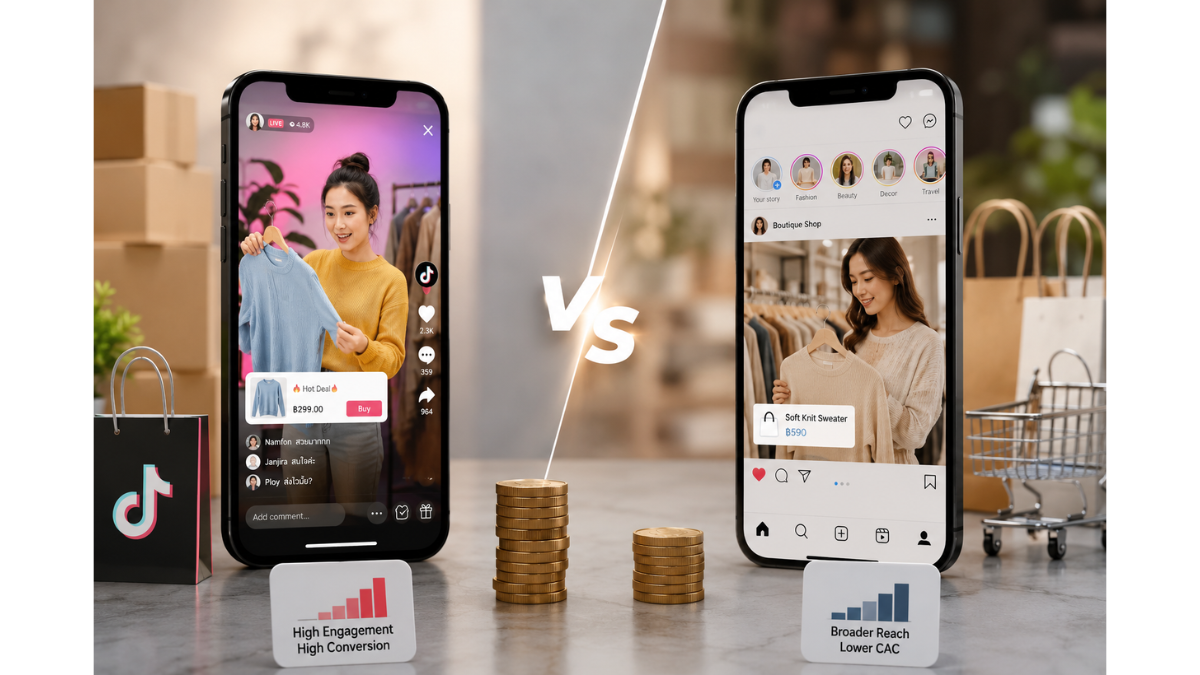
Take Control of Your Margins Today
Navigating the extreme complexities of digital retail requires an infrastructure built specifically for financial independence. Therefore, if you are ready to stop renting your customer base and start scaling your profit margins sustainably, Halo Tech Media is your definitive partner in digital transformation.
Reach out to Halo Tech Media today for a comprehensive consultation, or subscribe to our premier website packages, and let us build the indestructible digital fortress your brand truly deserves.
Frequently Asked Questions
What is the difference between TikTok Shop and social commerce?
TikTok Shop is selling directly inside TikTok with native checkout; social commerce is the broader practice of selling across social platforms. TikTok Shop is one channel within social commerce.
Does TikTok Shop offer better margins?
Not always. TikTok Shop drives viral discovery and convenience but charges fees that pressure margins. Whether it beats other channels depends on your product economics and acquisition costs.
Should brands sell on TikTok Shop?
It suits brands with visual, impulse-friendly products and content capacity. Many brands use it for discovery while diversifying sales across channels to protect margins and reduce platform risk.
 Back
Back