
Winning at Sustainability: The Tech Strategy for Zero-Paper Events
Zero-paper events replace printed tickets, programmes and signage with digital tools — cutting waste and cost while improving the attendee experience. Event technology makes sustainable, paperless events practical and impressive at any scale.
Every year, the global events industry prints billions of pages: tickets, programmes, registration forms, signage, sponsor brochures, and feedback slips. Most of it ends up in a bin by the time attendees reach the car park. For event professionals who are serious about reducing their environmental impact, the single most immediate lever is eliminating paper from the event lifecycle entirely.
The good news is that the technology to do this already exists, and it works remarkably well. Integrated event platforms are systems that connect registration, check-in, communication, and content delivery in one digital ecosystem. They are now sophisticated enough to replace every paper touchpoint, from pre-event invitations to post-event certificates. What once required a box of lanyards and a stack of printed agendas now fits inside a smartphone.
Why paper is still a problem at events
Despite widespread awareness of sustainability issues, many corporate events and conferences continue to operate on paper-heavy workflows. This persists partly out of habit and partly because the alternatives have not been clearly communicated to event planners. A standard 500-person conference can easily consume 15,000 to 20,000 printed sheets across all touchpoints: registration packs, name badges, maps, session schedules, evaluation forms, and exhibitor materials.
Beyond the raw environmental cost (paper production accounts for roughly 26% of landfill waste in many developed economies) there is a significant operational burden as well. Printing and logistics add cost, introduce last-minute errors that cannot be corrected once printed, and create a poor attendee experience when programmes go out of date the moment a session is rescheduled.
“Going paperless is not just an environmental win. It gives event teams real-time flexibility that printed materials simply cannot offer. Change a speaker at 8am, and every attendee sees the update on their phone by 8:01.”
The integrated platform approach
The most effective zero-paper strategies do not rely on a patchwork of different apps. They use an integrated event platform, which is a single system that handles the full event lifecycle, so data flows seamlessly from registration through to post-event analytics without being printed out at any stage.
Accupass, the largest event platform in Asia and an official partner of Halo Tech Media, is a strong example of what a mature integrated platform looks like in practice. Organisers can manage ticketing, attendee communication, check-in, and data reporting from one dashboard, with attendees experiencing everything through a mobile-first interface that replaces every piece of paper they would otherwise receive.
Key components of a paperless event platform ecosystem include:
- Digital registration and ticketing: QR code tickets delivered via email or in-app, eliminating printed tickets and registration forms entirely
- Self-service check-in kiosks: allowing attendees to check in independently, verify identity, and receive a digital or printed badge without any manual paper-based processing
- Digital event programmes and agendas: accessible via mobile app or personalised URL, with real-time updates pushed to attendees as schedules change
- Instant digital badge printing: if physical badges are required, on-demand printing at kiosks means only what is needed gets printed, cutting waste dramatically
- RFID-based access control: wristbands or smart lanyards that replace paper tickets for multi-zone events, concerts, and festivals
- Post-event digital delivery: certificates, session recordings, and follow-up materials sent digitally rather than posted or handed out in printed folders
Digital check-in and QR code registration in practice
One of the most visible paperless wins is at the registration desk. Traditional check-in involves a printed attendee list, manual tick-offs, and physical badge envelopes prepared in advance. This process is slow, error-prone, and generates significant pre-event printing waste even for people who never show up.
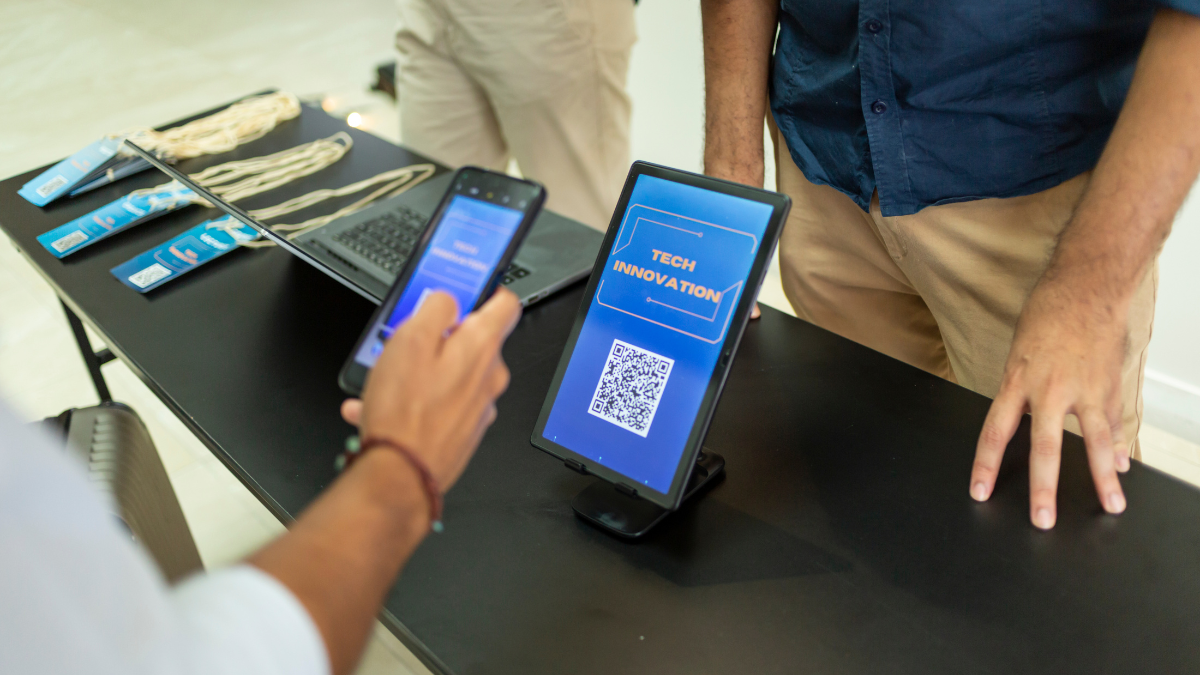
With QR code registration and digital check-in, attendees arrive with their ticket on a phone screen. A kiosk or handheld scanner reads the QR code, verifies the registration, and triggers instant badge printing. Alternatively, the physical badge can be skipped entirely for digital-first events. According to research from Eventbrite’s event operations team, digital check-in systems can process attendees up to three times faster than paper-based approaches, significantly reducing queue times at busy conferences.
Halo Tech Media’s registration kiosk solution is built to handle approximately 240 people per hour, which is fast enough for large corporate conferences and multi-session trade shows without the bottleneck that paper lists invariably create.
AI photography: a surprising ally for paperless events
One area that does not immediately come to mind in the sustainability conversation is event photography distribution, yet it matters more than many realise. Traditionally, photographers hand over a hard drive or USB stick, event teams manually curate hundreds of images, and attendees either receive a printed photo pack or wait weeks for an email link.
AI Cloud Photography changes this entirely. Photos are synced to the cloud in real time, automatically selected and colour-corrected by AI within 5 to 10 minutes, and made available to attendees via a facial recognition search. Attendees simply take a selfie to find their own photos instantly. The result is a completely paperless photo distribution workflow that also drives significantly higher social sharing. Halo Tech Media’s clients have seen up to a 70% increase in social media shares, while the printed photo deliverable is eliminated altogether.

Measuring the impact: carbon footprint and green meetings standards
Going paperless is now a recognized component of formal sustainability frameworks for events. The ISO 20121 standard for sustainable events explicitly includes resource consumption (paper among them) as a key area for management and reduction. Events pursuing green meetings certification from bodies like the Sustainable Event Alliance are expected to demonstrate paperless or low-paper operations across major touchpoints.
For corporate sustainability reporting, the shift to digital event management also contributes to Scope 3 carbon emissions reductions, which are the indirect emissions generated through business activities including events. With environmental reporting requirements tightening across markets in Europe and Southeast Asia, event teams that can demonstrate measurable paper elimination are increasingly valuable to procurement and CSR departments.
A fully digital 500-person conference can avoid printing an estimated 15,000 to 20,000 sheets of paper, equivalent to roughly 2 trees and 500 litres of water saved per event.
Getting started: what to look for in an event technology partner
Not every event platform is built with integration in mind. Many are point solutions, such as a ticketing tool in one place and a check-in app in another, that require manual data transfer between systems. This is both operationally messy and often results in paper being printed to bridge the gap. The key is to work with a provider that offers genuine end-to-end digital coverage.
When evaluating platforms, look for:
- Native QR code generation and scanner support at check-in
- Real-time attendee data sync between registration and on-site systems
- Mobile-first agenda and content delivery for attendees
- On-demand badge printing only, with no bulk pre-printing
- Post-event digital certificate and content delivery
- RFID integration for access control at larger events
- Analytics dashboards that measure attendance, engagement, and sustainability metrics in one place
It also matters that your technology partner has genuine operational experience, not just software. Setting up kiosks correctly, calibrating check-in flows for different audience sizes, and integrating RFID into a venue’s existing infrastructure all require hands-on expertise that pure SaaS providers often cannot supply.
The bottom line
Paperless event management is no longer aspirational. It is practical, cost-effective, and well-supported by mature technology. The carbon footprint argument is compelling on its own, yet the operational benefits are equally persuasive: faster check-in, real-time flexibility, richer attendee data, and lower last-minute printing costs. For event professionals who want to demonstrate genuine sustainability progress, integrated event technology is the clearest path to zero-paper events that work at scale.
Ready to take your events paperless?
Halo Tech Media offers end-to-end event technology solutions, from QR code registration and self-service kiosks to AI Cloud Photography and RFID access control. As an official partner of Accupass, Asia’s largest event platform, we combine enterprise-grade software with on-the-ground operational expertise.
References and Sources
- U.S. Environmental Protection Agency. Paper and Paperboard: Material-Specific Data. epa.gov
- Eventbrite. Event Check-in Solutions and Best Practices. eventbrite.com
- International Organization for Standardization. ISO 20121:2012 — Event Sustainability Management Systems. iso.org
- Sustainable Event Alliance. Green Meetings Certification Framework. sustainableeventalliance.com
- Accupass. About Accupass — Asia’s Largest Event Platform. accupass.com
Frequently Asked Questions
What is a zero-paper (paperless) event?
A zero-paper event replaces printed materials — tickets, programmes, forms, signage — with digital alternatives like mobile check-in, event apps and digital screens, eliminating paper waste.
How do you run a paperless event?
Use online registration and e-tickets, QR/contactless check-in, a mobile event app for agendas and updates, digital signage, and online feedback forms — all supported by the right event tech platform.
What are the benefits of sustainable, paperless events?
Lower waste and cost, faster and smoother attendee experiences, real-time updates, richer data capture, and a credible sustainability story that resonates with modern audiences and sponsors.
 Back
Back