
Events with Real-time AI Cloud Photography
The modern event attendee is no longer a passive observer; they are a co-creator of content. In an era defined by the “Experience Economy,” the value of a live event is often measured not just by what happens in the room, but by how shareable those moments are in the digital ether. Consequently, the pressure on brands to provide instant, high-quality, and personalized digital assets has never been higher.
Traditional engagement methods are rapidly evolving to meet this demand. Among the most significant shifts is the transformation of the humble photo booth. Once a corner novelty with feather boas and oversized sunglasses, the photo station has matured into a sophisticated, data-driven touchpoint powered by artificial intelligence.

The Psychology of Immediacy: Why Speed Matters
Human attention spans have evolved alongside our technology. According to a celebrated study by Microsoft, the average human attention span has dropped to approximately eight seconds, highlighting the fiercely competitive nature of the digital landscape. Microsoft, “Attention Spans Consumer Insights”. Therefore, the window for a brand to capitalize on the excitement of an event is incredibly narrow.
Previously, event photography suffered from a “latency gap.” A photographer would take high-quality images, but attendees might not see them until days later—if they could find them at all in a massive Facebook album. By the time the photo was available, the emotional high of the event had dissipated.
Real-time AI bridges this gap. It capitalizes on the psychological concept of immediate gratification. When an attendee receives a professional-grade photo of themselves minutes after it was taken, the emotional connection to the event is still at its peak. This immediacy significantly increases the likelihood of social sharing, turning the attendee into an authentic brand advocate.
From Novelty to Neural Networks: The Tech Behind the Transformation
The leap from standard digital photography to AI-enhanced solutions represents a massive technological stride. Modern AI photo booths and cloud photography solutions utilize computer vision and machine learning algorithms to automate complex tasks that previously required human intervention.
Key technological advancements driving this revolution include:
- Computer Vision & Facial Recognition: Algorithms can now map facial features with high precision, allowing systems to identify specific individuals within a crowd or a database of thousands of images instantly.
- Automated Post-Processing: AI tools can adjust exposure, color balance, and lighting in real-time, mimicking the editing style of a professional retoucher without the time delay.
- Semantic Segmentation: This allows the AI to understand the difference between the subject and the background, enabling dynamic background replacement or depth-of-field effects without a green screen.
According to McKinsey & Company, companies that excel at personalization generate 40 percent more revenue from those activities than average players. McKinsey & Company, “The value of getting personalization right”. In the context of events, personalization means delivering the right photo to the right person at the exact right moment.
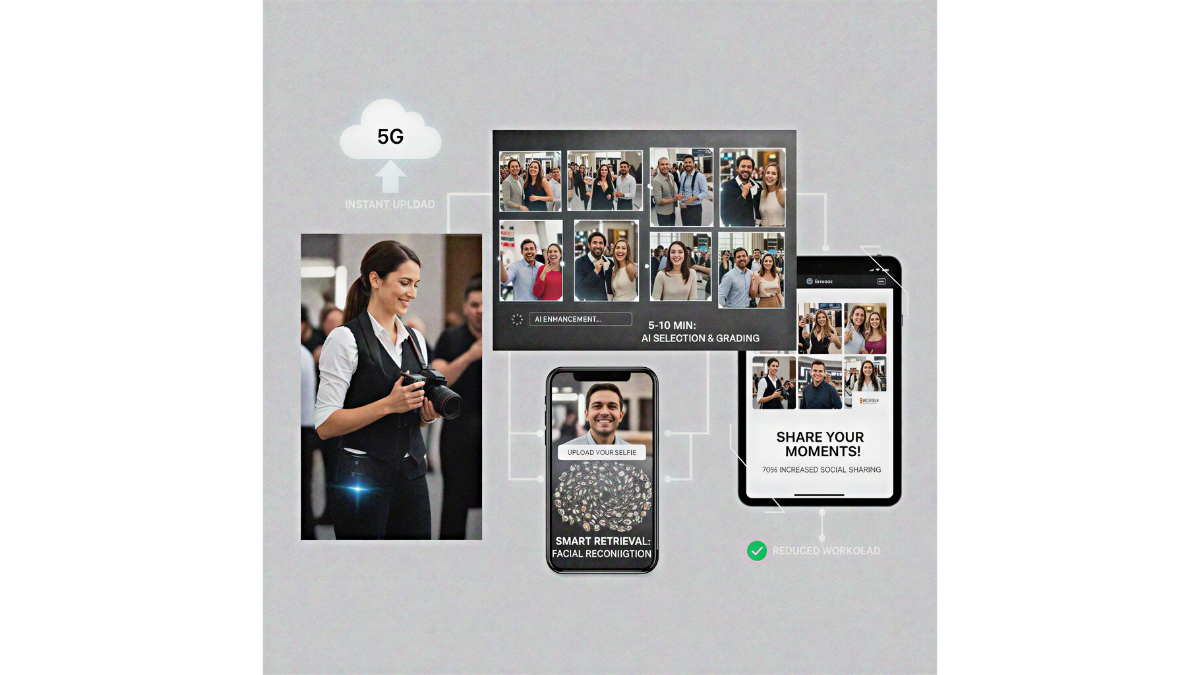
The Halo Tech Media Approach: A Case for “AI Cloud Photography”
As an end-to-end event solutions provider and an official partner of ACCUPASS, the largest event platform in Asia, Halo Tech Media has engineered a workflow that addresses the friction points of traditional event photography. Our flagship solution, AI Cloud Photography, serves as a prime example of this technology in action.
Here is how the strategic application of this technology transforms the workflow:
- Capture & Instant Upload: Professional photographers roam the event, capturing candid and staged high-resolution moments. Rather than storing these on SD cards for later processing, photos are uploaded instantly to the cloud via tethered connections or 5G.
- AI-Driven Enhancement: Within 5 to 10 minutes, AI algorithms automatically select the best shots (filtering out blinks or blur) and apply professional grading—adjusting lighting, skin tones, and color balance.
- Smart Retrieval: This is the critical differentiator. Using advanced facial recognition, attendees simply upload a selfie to a dedicated landing page. The system instantly scans thousands of event photos to find every image featuring that attendee.
- Branding Integration: The AI automatically applies watermarks or branded frames that are aesthetically pleasing, ensuring brand visibility travels with the content.
The results are tangible. We have documented up to a 70% increase in social sharing compared to traditional methods. Furthermore, this automation significantly reduces the workload for organizers, who no longer need to manage massive file transfers or handle “where is my photo?” inquiries post-event.
The Business Case: Data, Reach, and ROI
Implementing real-time AI photography is not merely an aesthetic choice; it is a strategic business decision.
1. Amplified Brand Reach via UGC
User-Generated Content (UGC) is the gold standard of social proof. Nielsen reports that 92% of consumers trust earned media, such as recommendations from friends and family, above all other forms of advertising. Nielsen, “Global Trust in Advertising”. When an attendee shares a branded, high-quality photo of themselves, they are effectively endorsing the event to their network.
2. Richer Data Analytics
Interactive photo experiences provide a wealth of first-party data. By having users log in or upload a selfie to retrieve photos, organizers can capture opt-in data such as email addresses and social media handles. Moreover, the AI can analyze aggregate data—such as demographic breakdowns (age, gender estimation) and peak engagement times—helping strategists refine future events.
3. Sponsor Satisfaction
For sponsored events, ROI is paramount. AI photo overlays allow for dynamic sponsor placement. Unlike a static physical banner that might be cropped out of a selfie, digital watermarks ensure the sponsor’s logo is intrinsic to the shareable asset.
Navigating Ethics: Privacy and Consent
Innovation must always be balanced with responsibility. The use of facial recognition technology raises valid privacy concerns. Consequently, it is imperative that event organizers and technology partners like Halo Tech Media operate with strict ethical guardrails.
Transparency is non-negotiable. Best practices include:
- Explicit Opt-In: Attendees should grant permission for facial scanning, usually via a term of service checkbox when they upload their search selfie.
- Data Minimization: Facial data should be used solely for the purpose of photo retrieval and deleted after a set period.
- GDPR/PDPA Compliance: Adhering to regional data protection regulations is essential for global events.
Trust is the currency of the digital age. Ensuring attendees feel safe using these tools is as important as the technology itself.
The Future: Generative AI and Immersive Worlds
Looking ahead, the convergence of Generative AI and event photography promises even more radical changes. We are moving beyond simple photo retrieval toward “memory enhancement.”
Future iterations may include:
- Generative Backgrounds: Using prompts to transport attendees to fantastical digital worlds that match the event theme, generated on the fly.
- Video Transformation: As we see with models like Google’s Veo, the ability to generate high-fidelity video from static inputs is on the horizon. Imagine an attendee taking a photo and receiving a 10-second cinematic, AI-generated video clip of them “starring” in the event’s brand story.
- Real-time Style Transfer: Instantly turning event photos into art pieces—cyberpunk, oil painting, or sketch styles—that match the event’s creative direction.
Strategic Takeaways for Marketers
The revolution in event photography is driven by a simple truth: people value themselves. By placing the attendee at the center of the narrative and removing the friction between “experience” and “share,” brands can unlock exponential reach.
To maximize the impact of your next event, consider the following:
- Prioritize Speed: If the content isn’t available instantly, its value drops every minute.
- Reduce Friction: The fewer clicks it takes for an attendee to find their photo, the better. Facial recognition is the key to this seamlessness.
- Integrate, Don’t Interrupt: Technology should enhance the live experience, not distract from it.
Ready to Elevate Your Next Event?
Halo Tech Media is a premier digital marketing and event technology agency providing end-to-end solutions, from pre-event planning to post-event analytics. As an official partner of ACCUPASS, the largest event platform in Asia, we specialize in bridging the gap between physical events and digital engagement through innovative technology.
about AI Cloud Photography or to discuss your next event strategy,
References and Sources
- Microsoft Attention Spans: Digital Lifestyles & Marketing
- The value of getting personalization right—or wrong—is multiplying | McKinsey
- Newswire | Consumer Trust in Online, Social and Mobile Advertising Grows | Nielsen
 Back
Back